A.Q Classical Homoeopathy Clinic, Lucknow


Dr.Saddam Homoeopathy
10 Homeopathic Medicines for Skin Eruption in Children
1. Apis Mellifica
Red, swollen rash + bee-sting jaisa burning/itching
Heat se badhta hai, cold se relief
2. Rhus Toxicodendron
Blister type rash, intense itching
Movement se better, rest se worse
3. Sulphur
Burning itching, raat me zyada khujli
Skin dry, red, scratch karne par jalta hai
4. Graphites
Dry, rough skin + sticky discharge
Eczema type chronic rash
5. Pulsatilla
Changeable rash (idhar-udhar shift hota hai)
Mild, sensitive children
6. Arsenicum Album
Burning itching, anxiety ke saath rash
Heat se relief
7. Calcarea Carbonica
Sweaty children, slow healing skin
Recurrent rashes
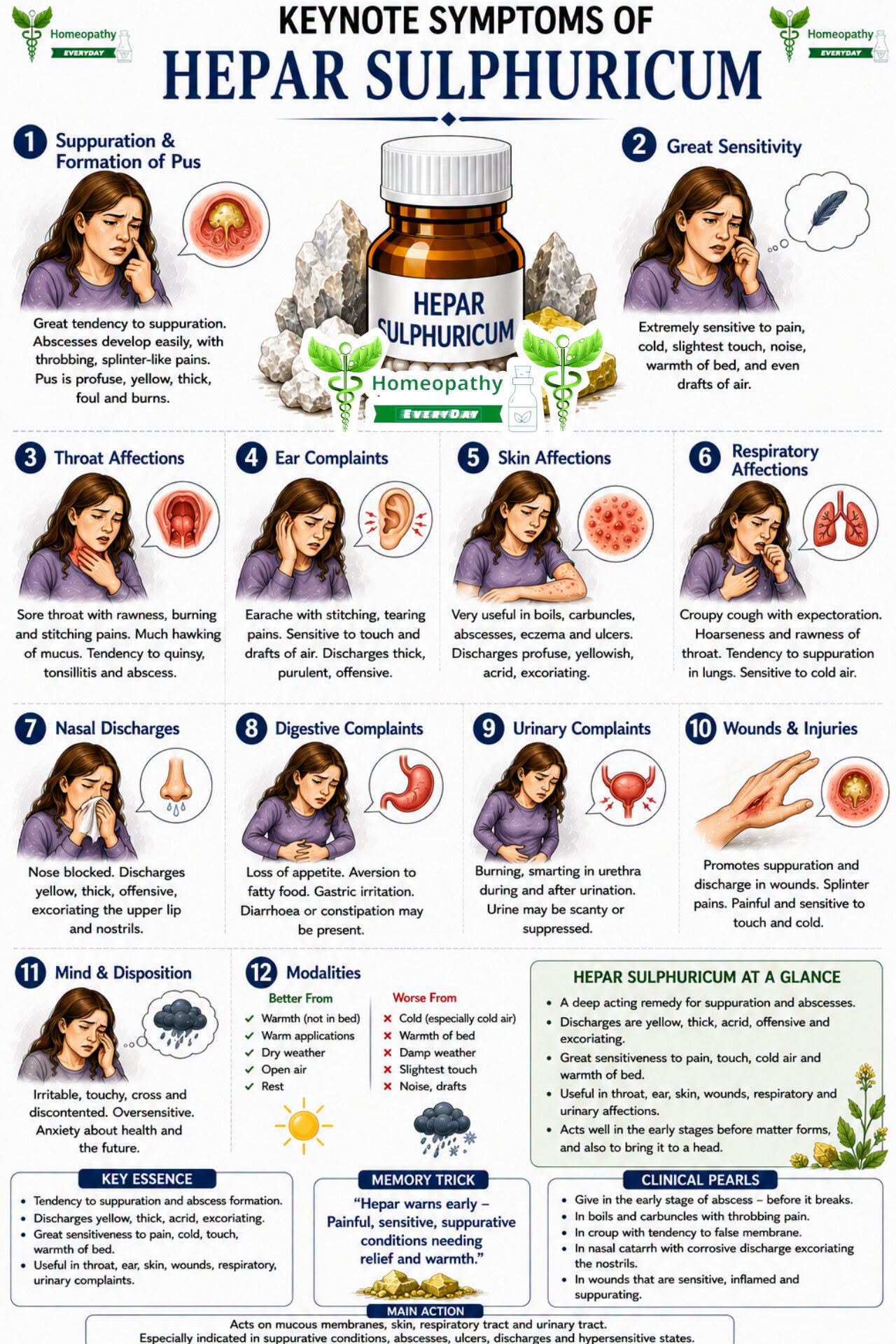
8. Hepar Sulphuris Calcareum
Very painful, touch sensitive rash
Pus formation tendency
9. Petroleum
Cracked, very dry skin
Winter me worse
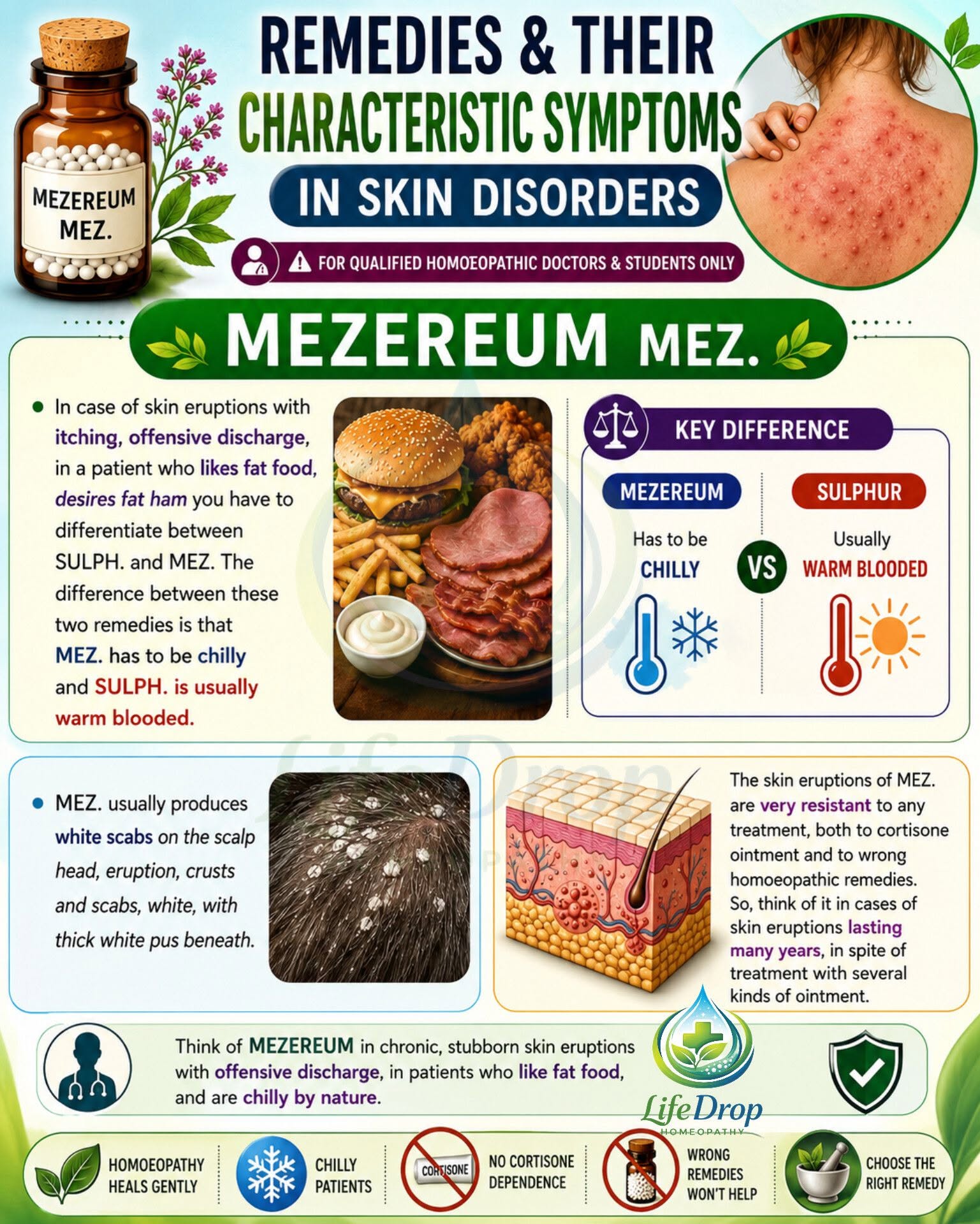
10. Mezereum
Thick crusts + itching
Scratching ke baad pain

10 left side paralysis (left hemiplegia / lakwa)– Homeopathic Medicines
1. Causticum
Left side facial + limb paralysis
Gradual weakness, speech affected
2. Rhus Toxicodendron
Stroke ke baad stiffness + paralysis
Movement se thoda relief
3. Gelsemium
Heavy, weak feeling in left side
Trembling + drowsiness
4. Nux Vomica
Stroke ke baad partial left weakness
Irritable, constipation, sedentary lifestyle history
5. Lachesis Mutus
Left-sided paralysis tendency
Worse after sleep, sensitive patient
6. Baryta Carbonica
Elderly patients, slow recovery
Memory + left weakness
7. Plumbum Metallicum
Severe left muscle wasting
Progressive paralysis
8. Kali Phosphoricum
Post-stroke nerve weakness
Mental + physical exhaustion
9. Belladonna
Sudden onset left paralysis with head symptoms
Red face, throbbing
10. Aconitum Napellus
Sudden paralysis after fear/shock
⚠️ Important Warning
Left side paralysis often stroke (brain issue) hota hai. Isme:
BP, sugar, MRI evaluation zaroori hota hai
Homeopathy supportive ho sakti hai, but emergency treatment delay nahi hona chahiye
Left side paralysis homeopathic treatment, hemiplegia medicine list, stroke left side
weakness remedies, lakwa homeopathy medicines, nerve paralysis treatment
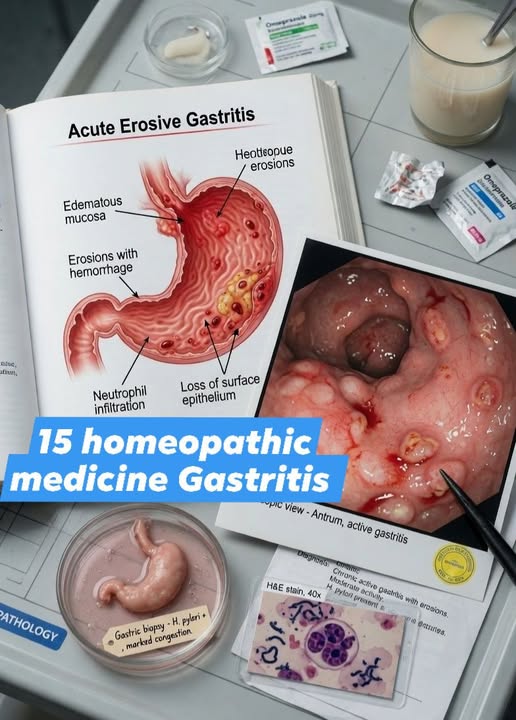
10 homoepoathic medicine Gastritis
1. Nux Vomica – overeating, spicy food, acidity, irritability
2. Arsenicum Album – burning pain, restlessness, nausea
3. Carbo Vegetabilis – gas, bloating, heaviness after meals
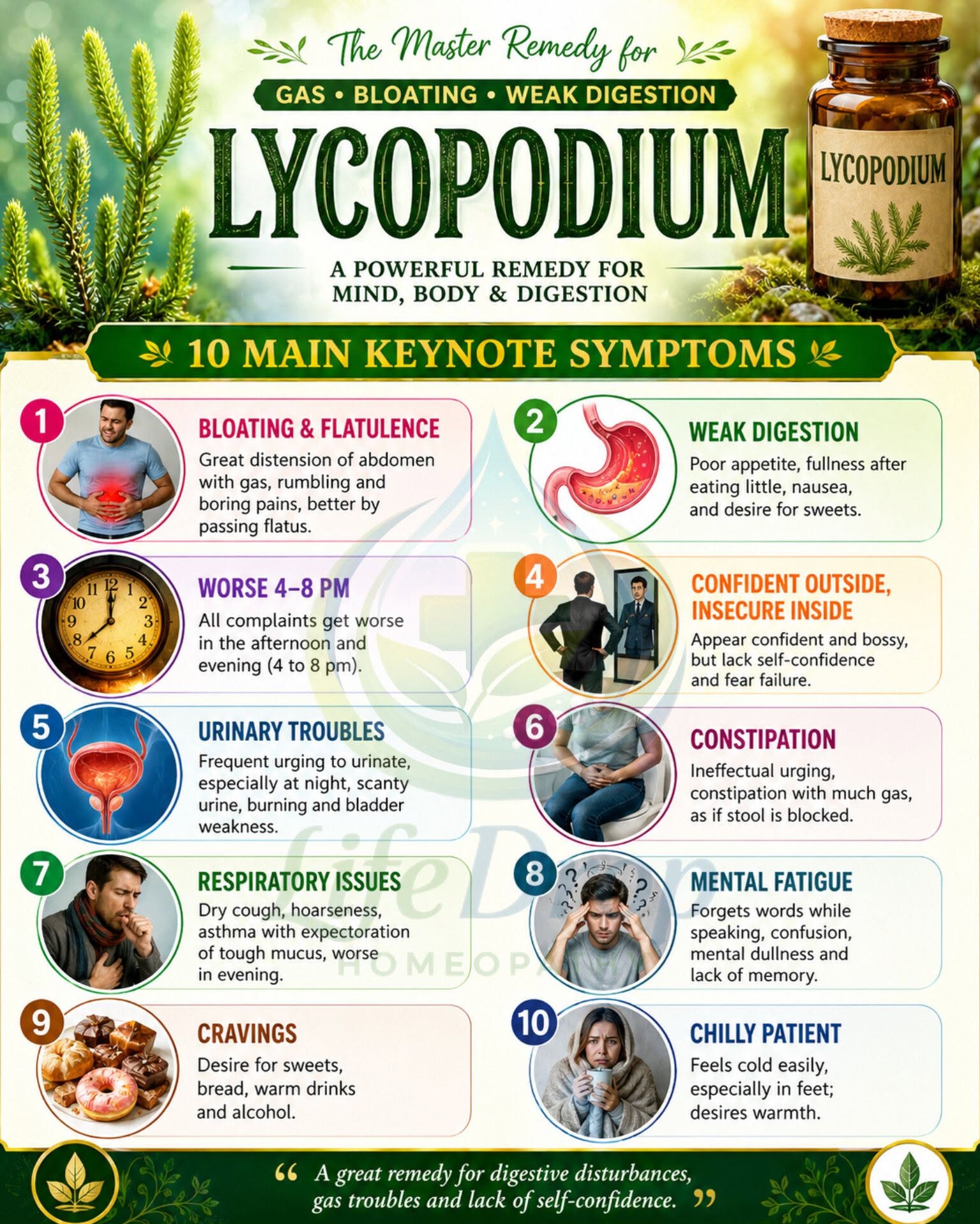
4. Lycopodium – excessive gas, fullness, evening bloating
5. Pulsatilla – indigestion after oily or rich food
6. Robinia – severe acid reflux and sour belching
7. Natrum Phosphoricum – hyperacidity, sour vomiting
8. Ipecacuanha – persistent nausea and vomiting
9. Bismuthum – stomach pain relieved by cold drinks
10. Hydrastis Canadensis – chronic gastritis with weakness
11. Phosphorus – burning in stomach, vomiting after eating
12. Antimonium Crudum – white-coated tongue, indigestion after overeating
13. Kalium Bichromicum – gastritis with thick mucus and heaviness
14. Iris Versicolor – acidity with burning from stomach to throat
15. Bryonia Alba – gastric pain worse from movement
These remedies are commonly mentioned in homeopathic references
for gastritis symptoms, though scientific evidence for effectiveness
remains limited and treatment is usually individualized.
⚠️ Warning signs needing medical evaluation:
vomiting blood
black stools
severe weight loss
persistent stomach pain
difficulty swallowing

10 Homeopathic Medicines for Pimples / Acne Explained
1. Sulphur
Used for oily skin with red, itchy, burning pimples. Acne may become worse from heat, sweating, or washing the face frequently. People needing Sulphur often have
unhealthy-looking skin with recurrent eruptions.
2. Hepar Sulph
Helpful in painful pus-filled pimples that are very sensitive to touch.
Acne may look infected and can hurt even with slight pressure.
Often considered when pimples are about to form pus.
3. Silicea
Commonly discussed for deep cystic acne and slow-healing pimples.
It may also be considered in acne scars and unhealthy skin where
eruptions keep returning repeatedly.
4. Kali Bromatum
Traditionally mentioned for large hard acne lesions on the face, chest,
and shoulders. Pimples may leave dark marks or scars after healing.
5. Natrum Mur
Often associated with oily skin and acne around the hairline or forehead.
Pimples may worsen during stress, emotional upset, or hormonal changes.
6. Berberis Aquifolium
Frequently used in homeopathic skin care discussions for acne marks, pigmentation,
and improving skin appearance. More commonly known for post-acne spots than
active
painful pimples.
7. Pulsatilla
Usually linked with hormonal acne, especially in teenagers or around
menstrual changes. Pimples may worsen after eating rich or oily foods.
8. Calcarea Sulphurica
Considered in yellow pus-filled pimples that heal slowly.
Acne may continue discharging for a long time before improving.
9. Belladonna
Used when pimples are bright red, hot, inflamed, and painful.
The surrounding skin may feel warm with sudden redness.
10. Antimonium Crudum
Discussed for hard eruptions with thick rough skin.
Acne may be associated with digestive complaints or
worsening after overeating.

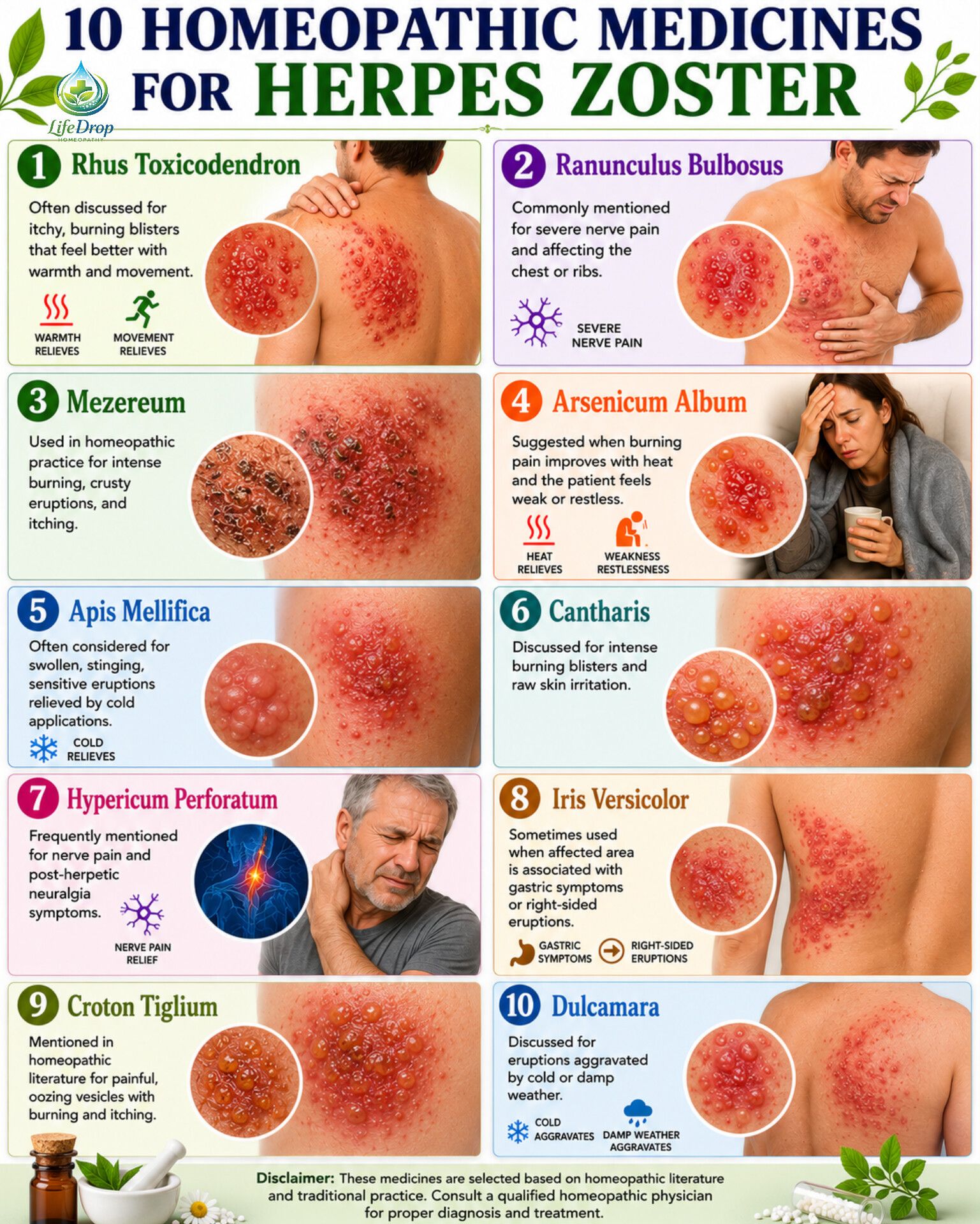
10 Homeopathic Medicines for Herpes Zoster
1. Rhus Toxicodendron
Often discussed for itchy, burning blisters that feel better with warmth and movement.
2. Ranunculus Bulbosus
Commonly mentioned for severe nerve pain and shingles affecting the chest or ribs.
3. Mezereum
Used in homeopathic practice for intense burning, crusty eruptions, and itching.
4. Arsenicum Album
Suggested when burning pain improves with heat and the patient feels weak or restless.
5. Apis Mellifica
Often considered for swollen, stinging, sensitive eruptions relieved by cold applications.
6. Cantharis
Discussed for intense burning blisters and raw skin irritation.
7. Hypericum Perforatum
Frequently mentioned for nerve pain and post-herpetic neuralgia symptoms.
8. Iris Versicolor
Sometimes used when shingles is associated with gastric symptoms or
right-sided eruptions.
9. Croton Tiglium
Mentioned in homeopathic literature for painful, oozing vesicles with burning and itching.
10. Dulcamara
Discussed for eruptions aggravated by cold or damp weather.

10 Homeopathic Medicines for Convulsions in Children
1. Belladonna
Best suited for sudden convulsions with high fever, hot red face,
dilated pupils, and jerking movements. Child may become stiff suddenly.
2. Cuprum Metallicum
Useful when hands and thumbs become tightly clenched during fits.
Face may turn bluish and spasms can be severe.
3. Chamomilla
Often considered when convulsions occur during teething.
Child becomes very irritable, cries excessively, and wants to be carried.
4. Cina
Helpful in children with convulsions related to worms or dentition.
Child may rub the nose, become restless, and grind teeth.
5. Aconitum Napellus
Used in sudden convulsions after fright, shock, or exposure
to cold dry wind. Restlessness and anxiety are common.
6. Cicuta Virosa
Considered in violent convulsions with body twisting backward,
stiffness, and severe muscle contractions.
7. Stramonium
Useful in severe spasms with fear, screaming, sensitivity to light,
or convulsions after fright.
8. Hyoscyamus Niger
Helpful when convulsions are associated with twitching,
unusual movements, or disturbed sleep.
Child may appear nervous or excitable.
9. Calcarea Carbonica
Often used in weak, sweaty, delayed-teething children
who are prone to recurrent convulsions.
10. Aethusa Cynapium
Useful in convulsions with weakness, staring eyes,
clenched thumbs, and intolerance to milk.
Important Warning
If a child has:
First-time seizure
High fever with convulsions
Breathing difficulty
Unconsciousness
Repeated fits
seek emergency medical care immediately.

10 Homeopathic Medicines for Child Abdomen Pain
1. Colocynthis
Useful when the child has severe cramping abdominal pain and bends double or presses the stomach for relief. Pain may come suddenly and make the child very restless.
2. Chamomilla
Often considered when abdominal pain occurs during teething.
The child becomes very irritable, cries continuously, and wants to be carried all the time.
3. Magnesia Phosphorica
Helpful for spasmodic or colicky pain that feels better
with warm applications or gentle pressure on the abdomen.
4. Nux Vomica
Commonly used for stomach pain linked with overeating, spicy food,
constipation, or indigestion. The child may feel bloated and irritable.
5. Podophyllum
Considered in abdominal pain associated with diarrhea,
gurgling sounds, weakness, and frequent loose stools.
6. Cina
Often discussed in children with abdominal pain related to worm complaints.
The child may grind teeth, rub the nose, or become unusually cranky.
7. Arsenicum Album
Used when abdominal pain is accompanied by vomiting,
burning sensation, anxiety, weakness, or restlessness.
8. Belladonna
Sometimes considered for sudden abdominal pain with fever,
flushed face, heat, and sensitivity to touch.
9. Lycopodium
Useful for gas, bloating, and fullness after eating small amounts.
Symptoms may become worse in the evening.
10. Carbo Vegetabilis
Often mentioned for abdominal discomfort with
excessive gas, heaviness, and bloating after meals.
Description
Abdominal pain in children can happen due to gas, constipation, indigestion,
infection, food intolerance, or worms. Proper diagnosis is important,
especially if pain is severe or recurrent.
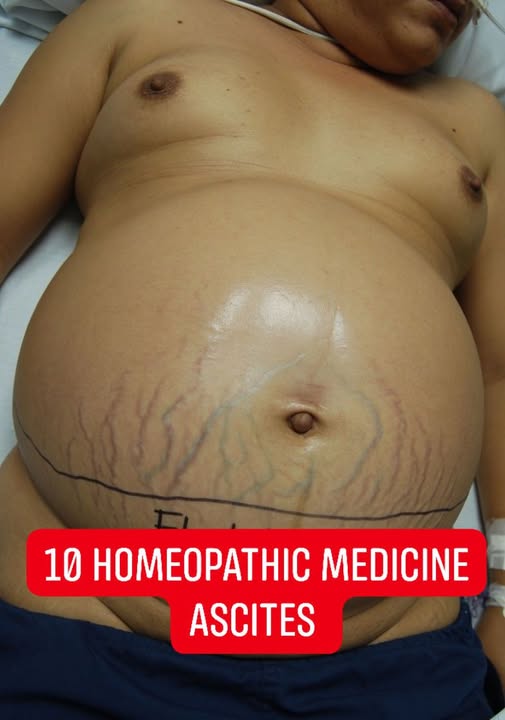
10 Homeopathic Medicines for Ascites
1. Apis Mellifica
Swelling with fluid retention
Thirstlessness
Burning or stinging sensations
Abdominal fullness
2. Arsenicum Album
Weakness and restlessness
Symptoms worse at night
Frequent small sips of water
Burning pains with edema
3. Apocynum Cannabinum
Commonly considered in ascites
Marked fluid retention
Bloated abdomen
Scanty urination
4. Lycopodium
Bloating and excessive gas
Liver-related complaints
Feeling full after small meals
Symptoms worse in evening
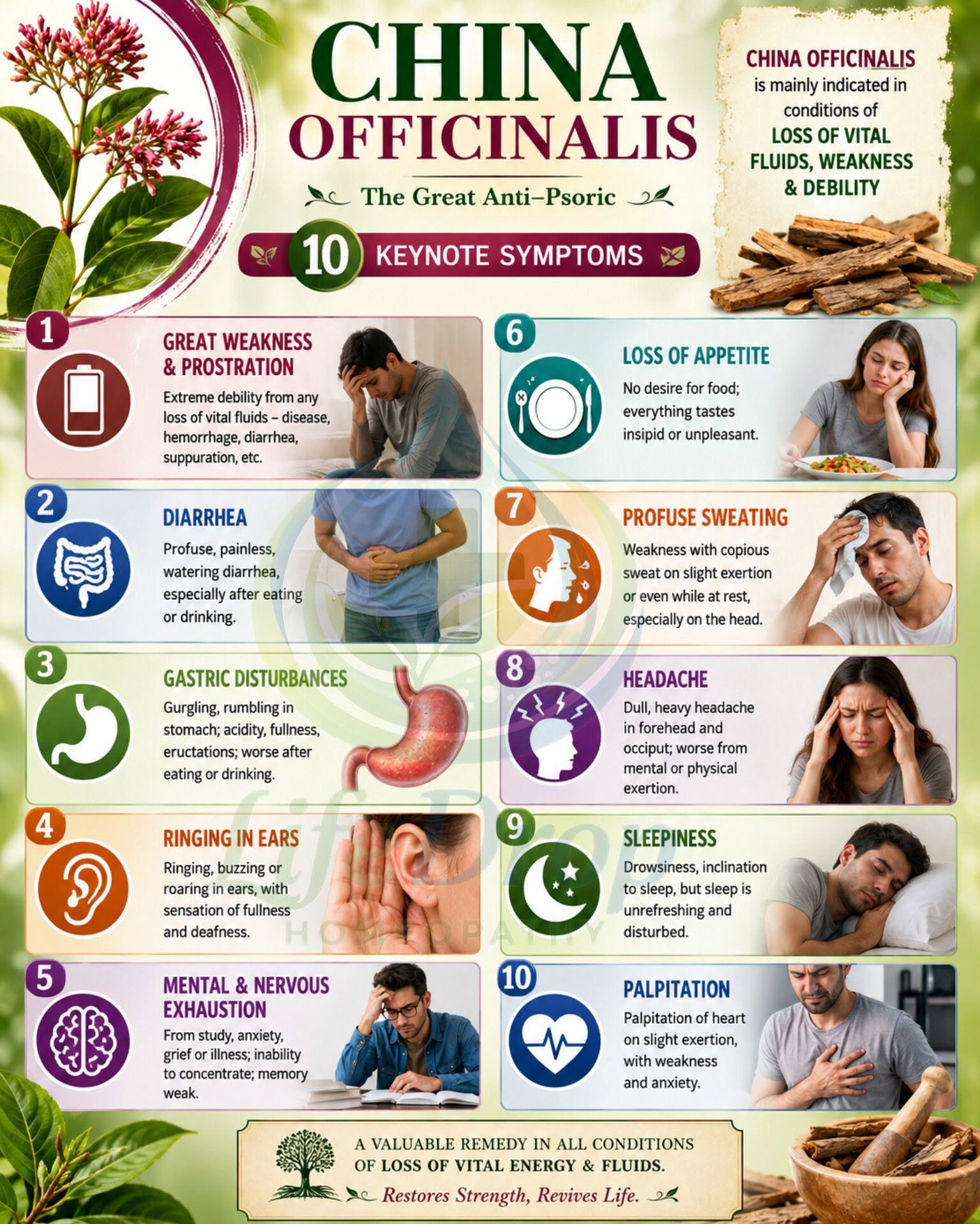
5. China Officinalis
Weakness after fluid loss
Abdominal distension with gas
Fatigue and exhaustion
Anemic tendency
6. Digitalis
Heart-related fluid accumulation
Slow pulse
Weakness with breathlessness
Swelling associated with cardiac issues
7. Helleborus Niger
Fluid accumulation with dullness
Mental sluggishness
Heaviness in abdomen
General weakness
8. Sulphur
Chronic conditions
Heat sensation in body
Skin complaints with weakness
Morning fatigue
9. Bryonia Alba
Pain aggravated by movement
Dryness with intense thirst
Heavy feeling in abdomen
Desire to remain still
10. Aurum Metallicum
Chronic liver or heart complaints
Weakness and low mood
Fluid retention in abdomen
Hypertensive tendency
Important Symptoms Requiring Medical Attention
Rapid abdominal swelling
Difficulty breathing
Leg swelling
Reduced urination
Jaundice or severe weakness
Disclaimer
This information is for educational awareness only.
Ascites can be a serious medical condition.
Do not take any medicine without proper consultation
from a qualified healthcare professional.

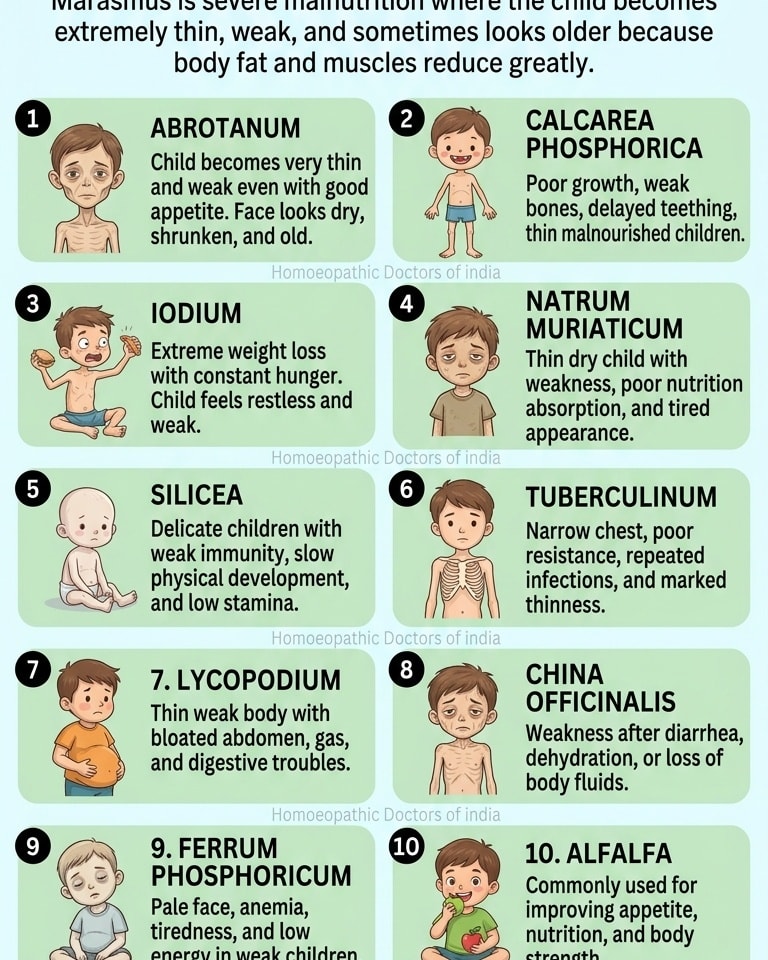
10 Homeopathic Medicines for Marasmus Child with Old Looking Face
Marasmus is severe malnutrition where the child becomes extremely
thin, weak, and sometimes looks older because body fat and muscles
reduce greatly.
1. Abrotanum
Child becomes very thin and weak even with good
appetite. Face looks dry, shrunken, and old.
2. Calcarea Phosphorica
Poor growth, weak bones, delayed teething,
thin malnourished children.
3. Iodium
Extreme weight loss with constant hunger.
Child feels restless and weak.
4. Natrum Muriaticum
Thin dry child with weakness, poor nutrition
absorption, and tired appearance.
5. Silicea
Delicate children with weak immunity,
slow physical development, and low stamina.
6. Tuberculinum
Narrow chest, poor resistance,
repeated infections, and marked thinness.
7. Lycopodium
Thin weak body with bloated abdomen,
gas, and digestive troubles.
8. China Officinalis
Weakness after diarrhea, dehydration,
or loss of body fluids.
9. Ferrum Phosphoricum
Pale face, anemia, tiredness,
and low energy in weak children.
10. Alfalfa
Commonly used for improving appetite,
nutrition, and body strength.
Important Points
Proper nutrition, protein, milk, fruits, and vitamins are very important.
Severe weakness, dehydration, fever, or inability to eat needs urgent medical care.
Homeopathic medicines are selected according to the child’s individual symptoms.
Disclaimer
This information is for educational purposes only
and not a substitute for professional medical treatment.
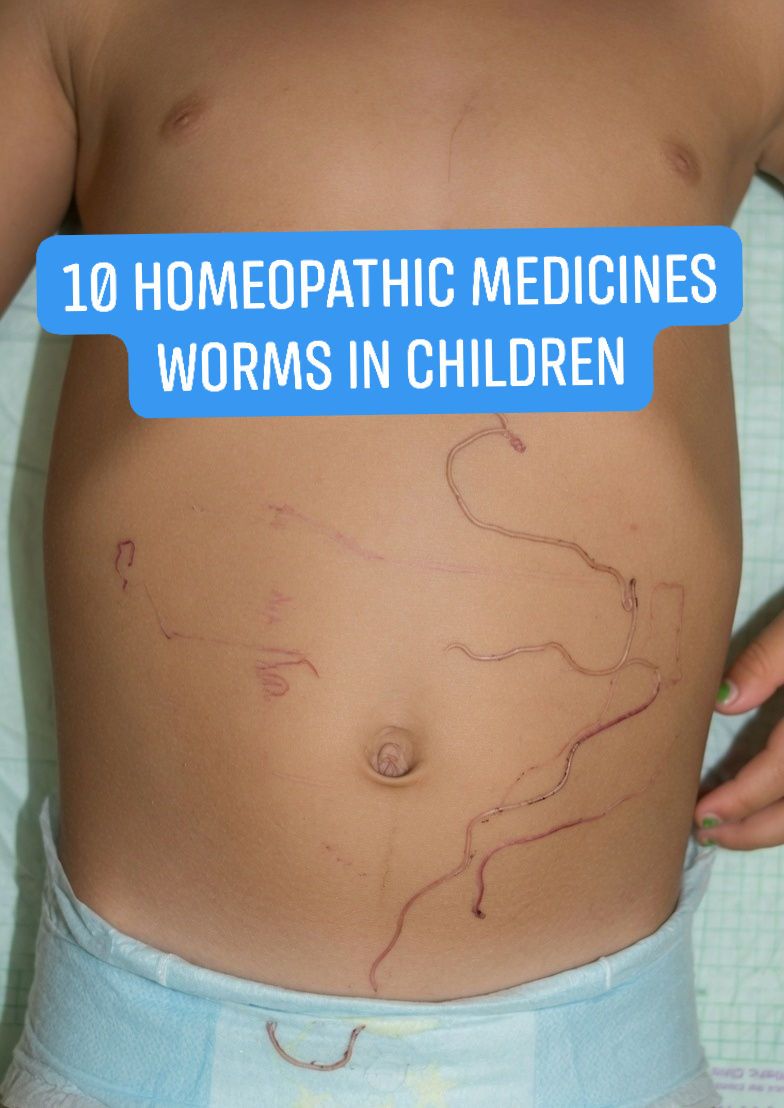
10 Homeopathic Medicines for Worms in Children
1. Cina
Child becomes very irritable, grinds teeth during sleep,
picks nose frequently, and may have abdominal pain with worm complaints.
2. Teucrium Marum Verum
Useful when there is intense itching
around the anus, especially at night.
3. Santoninum
Often considered when roundworm symptoms
include disturbed sleep and stomach irritation.
4. Spigelia
Helpful in worm complaints with abdominal pain
around the navel and nausea.
5. Calcarea Carbonica
Children who sweat excessively on the head,
crave eggs, and suffer repeated worm issues.
6. Natrum Phosphoricum
Used in children with sour belching,
acidity, and worm tendency.
7. Sulphur
Suitable for unhealthy-looking children with itching,
heat sensation, and recurrent worm infestation.
8. Mercurius Solubilis
Worm complaints with salivation,
offensive breath, and disturbed sleep.
9. Lycopodium
Bloating, gas, poor digestion,
and worm-related abdominal discomfort.
10. Filix Mas
Traditionally used in some worm-related
complaints, especially tapeworm tendency.
Important Points
Maintain hand hygiene and trimmed nails.
Wash fruits and vegetables properly.
Deworming and medical evaluation may be needed in persistent cases.
Repeated stomach pain, weight loss, vomiting, or blood in stool
should be checked by a doctor.

10 Homeopathic Medicines for Left-Sided Sciatica
Sciatica is pain that travels from the lower back into the hip, thigh,
and leg due to irritation of the sciatic nerve. Left-sided sciatica may
include pain, numbness, tingling, or weakness mainly on the left side.
1. Colocynthis
Severe left-sided sciatica with cramping or shooting pain
Pain better from hard pressure or bending double
Pain may extend from hip to thigh and leg
2. Gnaphalium
Sciatica with numbness and tingling
Alternating pain and numbness in the left leg
Useful when sitting worsens symptoms
3. Magnesia Phosphorica
Sharp, neuralgic, spasmodic pain
Better from warmth and pressure
Pain may come in sudden attacks
4. Rhus Toxicodendron
Stiffness and pain worse after rest
Better by continued movement and warm applications
Sciatica after strain or overexertion
5. Bryonia Alba
Pain worsens with slightest movement
Person prefers complete rest
Stitching pain in lower back and leg
6. Kali Iodatum
Intense night pain with restlessness
Pain may travel downward in the left leg
Helpful in chronic sciatica cases
7. Hypericum
Nerve injury–related sciatic pain
Tingling, burning, or shooting sensation
Useful after trauma or spinal injury
8. Aesculus Hippocastanum
Lower back weakness with radiating pain
Sacroiliac and hip discomfort on left side
Feeling of heaviness in back and legs
9. Tellurium
Sciatica with lightning-like radiating pain
Pain may worsen by coughing or sneezing
Often affects left side prominently
10. Lachnanthes
Neck and back stiffness with left-sided nerve pain
Tightness and drawing sensation along the leg
Worse from cold exposure
Supportive Measures
Avoid prolonged sitting
Use proper back support
Gentle stretching and walking may help
Warm fomentation can reduce stiffness
Seek medical care if weakness, bladder problems,
or severe numbness occur
Disclaimer
Homeopathic medicine selection depends on individual symptoms, cause,
and overall constitution. Severe or persistent sciatica should be evaluated
by a qualified doctor to rule out disc prolapse or nerve compression.

15 Homeopathic Medicines for Finger Arthritis – With Mind Symptoms
1. Rhus Toxicodendron
Joint Symptoms: Stiffness and pain, worse after rest, better from movement.
Mind: Restless, cannot stay in one position, anxiety at night.
2. Bryonia Alba
Joint Symptoms: Pain worsens with the slightest movement, better with rest.
Mind: Irritable, wants to be left alone, dislikes being disturbed.
3. Ruta Graveolens
Joint Symptoms: Soreness and stiffness from strain or overuse.
Mind: Feeling tired, discouraged, mentally exhausted.
4. Causticum
Joint Symptoms: Stiff, weak, or deformed finger joints.
Mind: Sympathetic, sensitive to injustice, easily affected by others‘ suffering.
5. Actaea Spicata
Joint Symptoms: Swollen, painful small joints of fingers.
Mind: Nervous, oversensitive, easily upset.
6. Ledum Palustre
Joint Symptoms: Pain begins in small joints and may spread upward.
Mind: Reserved, quiet, prefers solitude.
7. Arnica Montana
Joint Symptoms: Bruised, sore feeling in joints.
Mind: Says „I’m fine“ even when suffering; dislikes being approached.
8. Calcarea Fluorica
Joint Symptoms: Hard, enlarged finger joints.
Mind: Practical, cautious, concerned about security and stability.
9. Calcarea Carbonica
Joint Symptoms: Chronic stiffness and weakness.
Mind: Anxiety about health, overwhelmed by responsibilities.
10. Sulphur
Joint Symptoms: Burning pains and stiffness.
Mind: Independent thinker, forgetful, may appear untidy or absent-minded.
11. Kalmia Latifolia
Joint Symptoms: Sharp, shooting pains in joints.
Mind: Nervousness with pain, apprehensive about symptoms.
12. Guaiacum
Joint Symptoms: Marked stiffness, difficulty moving fingers.
Mind: Irritable and impatient due to discomfort.
13. Benzoic Acid
Joint Symptoms: Cracking joints, shifting pains.
Mind: Irritable, bothered by ongoing pain and limitations.
14. Dulcamara
Joint Symptoms: Pain aggravated by cold, damp weather.
Mind: Reserved, may become irritable when symptoms flare.
15. Formica Rufa
Joint Symptoms: Rheumatic stiffness and pain.
Mind: Mental fatigue, difficulty concentrating because of chronic discomfort.

15 Homeopathic Medicines for Bone Necrosis
Bone Necrosis refers to the death of bone tissue due to
reduced blood supply or chronic disease. The following remedies
are commonly mentioned in homeopathic literature based on symptom similarity:
1. Silicea – Chronic bone infections, caries, and slow healing of bone tissue.
2. Calcarea Phosphorica – Weak bones, delayed bone repair, and recovery after fractures.
3. Calcarea Fluorica – Hard, deformed, or weakened bone structures.
4. Phosphorus – Burning bone pains and degenerative bone conditions.
5. Fluoric Acid – Chronic necrosis and destructive bone processes.
6. Aurum Metallicum – Bone pains and caries, especially of facial bones.
7. Mercurius Solubilis – Bone inflammation with tenderness and suppuration.
8. Hepar Sulphuris – Bone infections with pus formation and extreme sensitivity.
9. Asafoetida – Deep, throbbing bone pains, often worse at night.
10. Mezereum – Severe bone pain with burning sensations and periosteal involvement.
11. Symphytum Officinale – Traditionally used to support bone healing after injury.
12. Ruta Graveolens – Pain involv. bones, periosteum, and tendons after strain or trauma.
13. Hypericum Perforatum – Nerve-rich injuries associated with bone trauma.
14. Kali Iodatum – Deep aching bone pains and chronic destructive bone conditions.
15. Nitric Acid – Chronic bone disease with fistulae and ulcerative processes.
Common Symptoms of Bone Necrosis
Persistent bone pain
Joint stiffness
Reduced movement
Swelling around the affected area
Pain worsening with activity
Disclaimer: Bone necrosis (including conditions such as Avascular Necrosis) is a serious medical condition. Homeopathic remedies are selected based on individual symptoms
and should not replace proper medical evaluation, imaging, and treatment by
a qualified healthcare professional.

15 Homeopathic Medicines Commonly Mentioned
for Brain Tumor (Educational Purpose Only)
1. Conium maculatum – Traditionally used in homeopathy for hard swellings.
2. Thuja occidentalis – Commonly discussed for abnormal tissue growth.
3. Calcarea fluorica – Used in homeopathic practice for firm tissue changes.
4. Silicea – Traditionally selected for chronic conditions.
5. Baryta carbonica – Sometimes used based on overall symptoms.
6. Phytolacca decandra – Associated with gland-related complaints in homeopathy.
7. Carcinosinum – Used by some practitioners according to individual symptoms.
8. Hydrastis canadensis – Traditionally mentioned for chronic weakness.
9. Arsenicum album – Often chosen for weakness and restlessness.
10. Lycopodium clavatum – Selected based on symptom patterns.
11. Phosphorus – Discussed for nervous system–related symptoms in homeopathy.
12. Sulphur – A commonly used constitutional remedy.
13. Kali iodatum – Traditionally mentioned for tissue-related complaints.
14. Calcarea phosphorica – Used in constitutional homeopathic approaches.
15. Aurum metallicum – Sometimes used in long-term cases.
Disclaimer: This content is for educational purposes only and is not medical advice.
Homeopathic medicines are not established treatments for brain tumors.
Brain tumors require diagnosis and treatment by a qualified healthcare professional.

10 Homeopathic Medicines for Enlarged
Neck Lymph Nodes in Children
1. Baryta Carbonica
Enlarged cervical glands with recurrent tonsillitis.
Shy, timid, or developmentally delayed children.
Useful when lymph nodes enlarge after repeated throat infections.
2. Baryta Iodata
Enlarged tonsils and lymph nodes together.
Frequent throat infections and swollen neck glands.
3. Calcarea Iodata
Hard, enlarged lymph nodes.
Children prone to recurrent colds and glandular swelling.
4. Calcarea Phosphorica
Thin, weak, growing children.
Enlarged glands with poor nutrition or slow growth.
5. Silicea
Chronic enlarged lymph nodes.
Tendency to suppuration (pus formation).
Sensitive and chilly children.
6. Tuberculinum
Recurrent respiratory infections.
Persistent enlargement of neck glands.
Restless children who frequently catch colds.
7. Conium Maculatum
Hard, painless, slowly enlarging lymph nodes.
Useful when glands remain enlarged for a long time.
8. Belladonna
Sudden swelling of lymph nodes.
Red, hot, painful glands with fever.
Acute inflammatory conditions.
9. Phytolacca Decandra
Enlarged glands associated with sore throat.
Pain radiating to the ears while swallowing.
10. Mercurius Solubilis
Swollen lymph nodes with tonsillitis.
Excessive salivation, bad breath, and throat inflammation.
Disclaimer
Homeopathic medicine selection should be based on the individual’s complete
symptom picture and professional assessment. Persistent, rapidly enlarging,
or unexplained lymph node swelling in a child requires medical evaluation.

15 Homeopathic Medicines Commonly Used in Diabetes
1. Syzygium Jambolanum
One of the most frequently used homeopathic remedies for diabetes.
It is often considered when there is excessive thirst, frequent urination,
weakness, and elevated blood sugar levels.
2. Uranium Nitricum
Used in cases where diabetes is associated with marked weight loss,
weakness, excessive hunger, and digestive disturbances.
3. Phosphoric Acid
Helpful for patients who become physically and mentally exhausted due to
long-term illness. They may have excessive urination, thirst, and general debility.
4. Lycopodium Clavatum
Indicated when diabetes is accompanied by bloating,
gas, digestive problems, and a craving for sweets.
5. Phosphorus
Considered when there is intense thirst for cold drinks,
burning sensations, weakness, and nervous sensitivity.
6. Cephalandra Indica
Traditionally used for excessive thirst, frequent urination,
dry mouth, and weakness associated with diabetes.
7. Natrum Sulphuricum
May be considered in diabetic patients with liver complaints,
obesity, or a tendency toward damp-weather aggravation.
8. Arsenicum Album
Suitable for patients who are anxious, restless, weak,
and experience burning pains along with excessive thirst.
9. Sulphur
Often indicated in individuals who feel hot, have skin complaints,
increased appetite, and a tendency toward metabolic disturbances.
10. Helonias Dioica
Used when extreme fatigue, backache, and exhaustion
are prominent symptoms in diabetic patients.
11. Lactic Acid
May be considered when diabetes is associated with excessive
hunger, nausea, digestive complaints, and weakness.
12. Insulinum
A homeopathic preparation sometimes used by practitioners
as a complementary remedy in diabetes management.
13. Gymnema Sylvestre
Traditionally associated with reducing cravings
for sweets and supporting metabolic balance.
14. Abroma Augusta
Often considered for intense thirst, weakness, irritability,
and symptoms associated with elevated blood sugar.
15. Calcarea Carbonica
May suit individuals who are overweight, tire easily,
perspire excessively, and have a tendency toward
metabolic disorders.
Important Note
Diabetes is a serious medical condition.
Homeopathic remedies should not replace prescribed diabetes
medications, insulin, dietary management, or regular medical monitoring.
Treatment should be guided by a qualified healthcare professional.
Disclaimer
This information is for educational purposes only and is not medical advice.
Always consult a qualified healthcare professional before starting, stopping,
or changing any treatment.

10 Homeopathic Medicines Commonly
Mentioned for Herpes Zoster (Shingles)
1. Ranunculus Bulbosus
Burning, stitching pain.
Blisters on chest and ribs.
Pain worsens with touch and movement.
2. Mezereum
Intense burning and itching.
Thick crusts after eruptions.
Neuralgic pain persists after rash.
3. Rhus Toxicodendron
Small fluid-filled vesicles.
Restlessness and itching.
Symptoms may improve with warmth.
4. Arsenicum Album
Burning pain relieved by warmth.
Anxiety and restlessness.
Weakness with skin eruptions.
5. Croton Tiglium
Intense itching and burning.
Sensitive vesicular eruptions.
Pain radiates along nerves.
6. Apis Mellifica
Swollen, red skin.
Stinging, burning pains.
Symptoms often improve with cold applications.
7. Hypericum Perforatum
Nerve-related pain.
Tingling and shooting sensations.
Useful when neuralgia is prominent.
8. Graphites
Sticky discharge from eruptions.
Cracked, unhealthy skin.
Delayed healing.
9. Sulphur
Marked itching and burning.
Chronic skin tendency.
Symptoms often worsen from heat.
10. Natrum Muriaticum
Herpetic eruptions around lips and face.
Neuralgic pain after eruptions.
Sensitive emotional state.
Description (Facebook Safe)
Herpes zoster (shingles) is a viral skin condition that may cause painful rashes
and blisters along nerve pathways. Homeopathic remedies are chosen according
to individual symptoms and should not replace professional medical care.

15 Homeopathic Medicines Commonly Discussed for Appendicitis –
1. Belladonna
Sudden, intense pain in the right lower abdomen.
High fever, flushed face, hot skin.
Abdomen very sensitive to touch or jarring.
2. Bryonia Alba
Pain becomes worse from the slightest movement.
Patient wants to lie completely still.
Dry mouth with increased thirst.
3. Arsenicum Album
Burning abdominal pain.
Anxiety, restlessness, and weakness.
Symptoms often worsen after midnight.
4. Mercurius Solubilis
Fever with profuse sweating.
Tender abdomen and digestive upset.
Offensive breath and increased saliva.
5. Lachesis
Abdomen extremely sensitive to touch.
Symptoms may worsen after sleeping.
Intolerance of tight clothing around the waist.
6. Rhus Toxicodendron
Restlessness with frequent position changes.
Pain and stiffness may improve slightly with movement.
Associated body aches.
7. Nux Vomica
Cramping abdominal pain.
Nausea, irritability, and digestive disturbance.
Frequent but ineffective urge for stool.
8. Colocynthis
Severe colicky pain.
Relief from firm pressure on the abdomen.
Patient may bend double because of pain.
9. Hepar Sulphuris
Used when suppuration (pus formation) is suspected.
Extreme sensitivity to pain and touch.
Chilly patient who wants warmth.
10. Echinacea
Traditionally considered in infection-related conditions.
Weakness and toxic feeling.
General exhaustion.
11. Baptisia Tinctoria
High fever with profound weakness.
Toxic, septic appearance.
Body aches and mental dullness.
12. Pyrogenium
Septic states with high fever.
Restlessness and marked weakness.
Feeling worse despite treatment.
13. Kali Bichromicum
Sharp, localized abdominal pain.
Digestive complaints with heaviness.
Symptoms often occur in a specific spot.
14. Cantharis
Intense burning sensations.
Irritability and restlessness.
May have urinary burning symptoms.
15. Arnica Montana
Bruised, sore feeling in the abdomen.
Patient dislikes being touched.
Sensation as if the abdomen has been injured.
Common Symptoms of Appendicitis
✔ Pain starting near the navel and
moving to the lower right abdomen
✔ Fever
✔ Nausea and vomiting
✔ Loss of appetite
✔ Pain that worsens with walking or coughing
✔ Abdominal tenderness
Disclaimer
Homeopathic medicine selection is individualized. Suspected appendicitis
requires urgent medical evaluation and should not be treated solely with
home remedies or homeopathy. This information is for educational purposes only.

15 Homeopathic Medicines Prostate Enlargement (BPH)
1. Sabal Serrulata
Frequent urination, especially at night
Weak urine stream
Sensation of incomplete emptying
2. Conium Maculatum
Interrupted urine flow
Difficulty starting urination
Dribbling after urination
3. Chimaphila Umbellata
Straining to pass urine
Feeling of pressure in the prostate region
Better when standing with feet apart
4. Thuja Occidentalis
Frequent urge to urinate
Split or forked urine stream
Associated urinary tract irritation
5. Baryta Carbonica
Enlarged prostate in elderly men
Weak bladder function
Frequent nighttime urination
6. Pareira Brava
Severe straining during urination
Pain extending to thighs
Sensation of obstruction
7. Clematis Erecta
Difficulty passing urine
Burning during urination
Interrupted stream
8. Lycopodium Clavatum
Retention of urine
Frequent urination at night
Weak urinary stream
9. Digitalis Purpurea
Urinary retention
Constant urge to urinate
Scanty urine output
10. Pulsatilla Nigricans
Frequent urination
Mild urinary discomfort
Symptoms may vary from day to day
11. Ferrum Picricum
Enlarged prostate with urinary difficulty
Frequent urge to urinate
Weakness in older men
12. Staphysagria
Urinary problems after prostate procedures
Feeling of pressure in bladder
Frequent urge to urinate
13. Selenium Metallicum
Dribbling of urine
Weak urinary control
Prostate enlargement in older age
14. Populus Tremuloides
Burning urination
Prostatic irritation
Frequent urination
15. Agnus Castus
Prostatic complaints with weakness
Reduced vitality
Difficulty in urination
Common Symptoms of Enlarged Prostate
✔ Frequent urination
✔ Night-time urination (Nocturia)
✔ Weak urine stream
✔ Dribbling urine
✔ Difficulty starting urination
✔ Feeling of incomplete bladder emptying
Prostate enlargement (BPH) is common in aging men and may cause frequent urination,
weak stream, and difficulty emptying the bladder. Homeopathic medicine selection
depends on the individual’s symptoms and constitution. Always seek professional
medical advice for proper diagnosis and treatment.

15 Homeopathic Medicines for Rheumatoid Arthritis –
1. Rhus Toxicodendron
– Traditionally discussed when joints feel stiff after rest and symptoms
seem better with gentle movement. Often associated with morning stiffness.
2. Bryonia Alba
– Traditionally considered when movement appears to worsen
joint pain and rest feels more comfortable.
3. Ledum Palustre
– Often discussed for painful, swollen joints,
especially when discomfort seems to move between joints.
4. Arnica Montana
– Traditionally used when joints feel sore, bruised, or tender.
5. Calcarea Carbonica
– Sometimes selected in homeopathic practice for people
with chronic stiffness, fatigue, and slower recovery feelings.
6. Causticum
– Traditionally associated with joint stiffness and weakness.
7. Actaea Spicata
– Commonly discussed for small-joint discomfort,
especially hands and fingers.
8. Colchicum Autumnale
– Traditionally considered when joints
feel very sensitive to touch and movement.
9. Kalmia Latifolia
– Often discussed when joint pain seems to shift or radiate.
10. Pulsatilla
– Traditionally associated with changing or variable symptoms.
11. Ruta Graveolens
– Often discussed for strain-like discomfort around joints and tendons.
12. Guaiacum
– Traditionally mentioned for marked stiffness and reduced flexibility.
13. Dulcamara
– Traditionally selected when symptoms seem worse in damp or cold weather.
14. Sulphur
– Sometimes discussed in long-standing cases with warmth and irritation sensations.
15. Calcarea Fluorica
– Traditionally associated with long-term stiffness and tissue firmness.
Important: Rheumatoid arthritis is an autoimmune disease that can damage
joints over time. Homeopathic remedies should not replace evaluation and
treatment by a qualified healthcare professional.
Disclaimer: Educational information only; not a prescription or diagnosis.
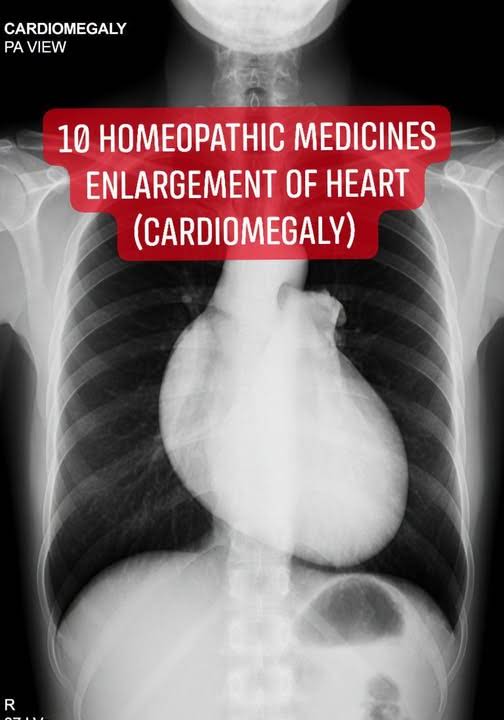
10 Homeopathic Medicines for Enlargement of Heart (Cardiomegaly)
1. Crataegus oxyacantha
Considered one of the most commonly used remedies for heart weakness.
May be used when there is fatigue, shortness of breath, and palpitations.
The patient may feel tired even after slight exertion.
2. Digitalis purpurea
Used when the pulse is slow, weak, or irregular.
The person may feel that the heart stops if they move suddenly.
Suitable for weakness of the heart with dizziness.
3. Cactus grandiflorus
Used when there is a sensation of tightness or constriction around the heart.
Palpitations and chest discomfort may be present.
Symptoms may worsen when lying on the left side.
4. Aurum metallicum
Considered when heart enlargement is associated with high blood pressure.
The patient may experience depression, heaviness in the chest, and palpitations.
5. Convallaria majalis
Used for breathlessness on exertion and weakness of the heart.
The patient may feel unable to walk without becoming short of breath.
6. Adonis vernalis
Considered when heart weakness is associated with swelling
of the feet or fluid retention.
May help improve circulation in selected cases.
7. Laurocerasus
Used for weakness, bluish discoloration, and difficulty in breathing.
The patient may feel cold and exhausted.
8. Spigelia anthelmia
Used for sharp, stabbing pain around the heart.
Palpitations may be felt strongly, especially when lying down.
9. Kalmia latifolia
Considered when pain radiates from the heart to the arm or shoulder.
Palpitations and irregular heartbeat may be present.
10. Arsenicum album
Used for anxiety, restlessness, weakness, and breathlessness.
Symptoms may become worse after midnight.
Important Note: An enlarged heart (Cardiomegaly) is a serious medical
condition and requires proper diagnosis and treatment by a qualified doctor.
Homeopathic medicines should only be used under professional guidance and
should not replace emergency or prescribed cardiac treatment.
Disclaimer: This information is for educational purposes only
and is not intended as medical advice or a substitute for professional care.
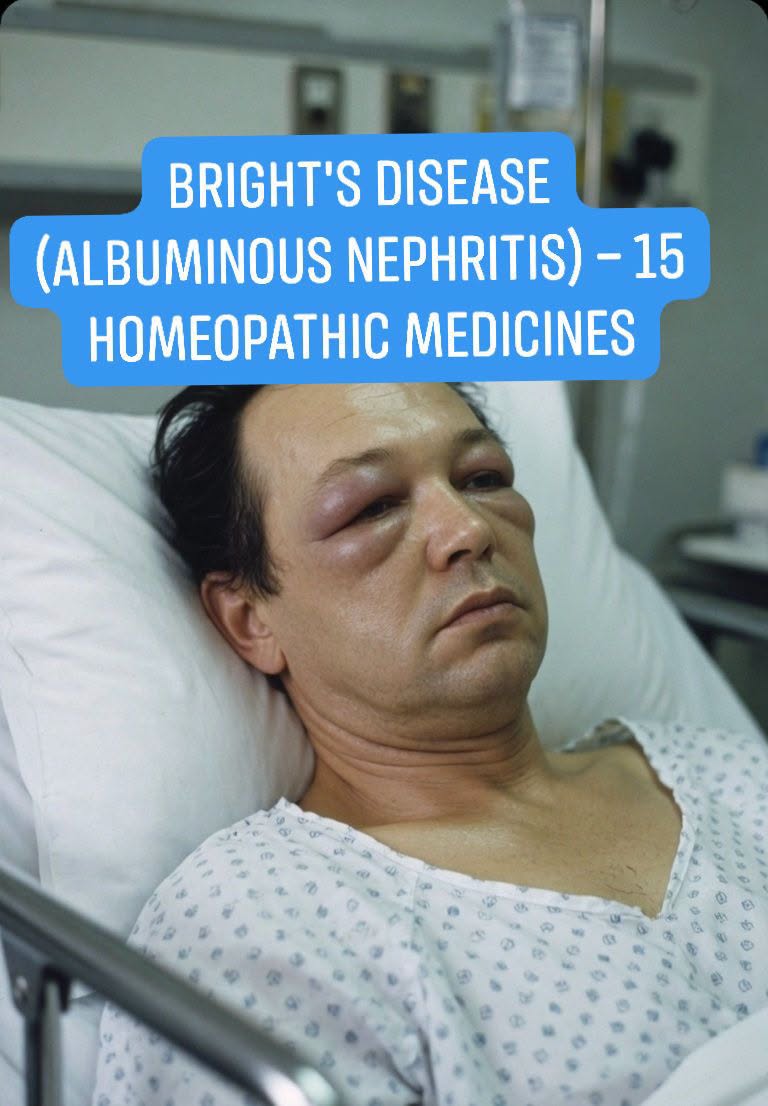
Bright’s Disease (Albuminous Nephritis)
– 15 Homeopathic
1. Apis mellifica
Key indications:
Puffiness of the face and eyelids.
Swelling of legs and feet.
Scanty or dark urine.
Burning or stinging pains.
2. Arsenicum album
Key indications:
Extreme weakness and restlessness.
Burning sensations.
Swelling with anxiety and exhaustion.
Worse after midnight.
3. Terebinthina
Key indications:
Dark, smoky, or blood-tinged urine.
Kidney irritation and pain.
Burning during urination.
4. Cantharis
Key indications:
Intense burning before, during, and after urination.
Frequent urge to pass small amounts of urine.
Severe urinary tract irritation.
5. Helonias dioica
Key indications:
Kidney weakness with fatigue.
Dull backache in the kidney region.
Albumin in the urine with exhaustion.
6. Solidago virgaurea
Key indications:
Kidney soreness and tenderness.
Reduced urine output.
General weakness.
7. Berberis vulgaris
Key indications:
Sharp, radiating kidney pain.
Pain extending to the bladder or thighs.
Urinary discomfort.
8. Mercurius corrosivus
Key indications:
Severe inflammation of the urinary tract.
Burning and painful urination.
Frequent urging.
9. Lycopodium clavatum
Key indications:
Kidney complaints with digestive problems.
Bloating and weakness.
Urinary disturbances.
10. Phosphorus
Key indications:
Weakness and fatigue.
Increased sensitivity and thirst.
Albumin in the urine.
11. Digitalis purpurea
Key indications:
Swelling with weakness.
Reduced urine output.
Slow, weak pulse.
12. Ferrum phosphoricum
Key indications:
Early inflammatory conditions.
Mild fever and weakness.
General debility.
13. Kali chloricum
Key indications:
Traditional use in some cases of nephritis.
Weakness and urinary complaints.
14. Plumbum metallicum
Key indications:
Chronic kidney complaints.
Weakness and gradual deterioration.
15. Cuprum arsenicosum
Key indications:
Severe weakness and exhaustion.
Kidney complaints associated with debility.
Disclaimer:
For educational purposes only. This content is not intended to diagnose, treat,
cure, or replace professional medical advice. Consult a qualified healthcare
professional before taking any medicine.
Seek urgent medical care if there is:
Marked swelling of the face or legs.
Very little or no urine.
Blood in the urine.
Severe shortness of breath.
High blood pressure or confusion.
Kidney disease can be serious and should be
monitored by a qualified healthcare professional.

15 Homeopathic Medicines for Anemia
Anemia is a condition in which the hemoglobin or red blood cells
in the body become low, causing weakness, fatigue, dizziness, and pale skin.
1. Ferrum Metallicum
One of the most commonly used remedies for anemia.
Indicated in pale people who become easily tired, weak, and breathless.
Complaints may worsen after slight exertion.
2. Ferrum Phosphoricum
Useful in early stages of anemia with weakness and low energy.
Suitable for people who look pale and feel exhausted.
3. Calcarea Phosphorica
Often considered for children and adolescents with poor nutrition and anemia.
Helpful in weakness, slow growth, and poor appetite.
4. China Officinalis
Traditionally used when anemia develops after blood loss,
heavy periods, or prolonged illness.
Weakness and dizziness are prominent symptoms.
5. Natrum Muriaticum
Considered for anemia with headaches, weakness, and emotional stress.
Patients may appear thin and easily fatigued.
6. Pulsatilla
Used in mild, gentle individuals with poor circulation and anemia.
May be considered when hormonal disturbances accompany anemia.
7. Arsenicum Album
Helpful for extreme weakness, restlessness, and exhaustion.
The person may feel chilly and anxious.
8. Kali Phosphoricum
Often used for physical and mental fatigue due to anemia.
Useful in weakness after overwork or stress.
9. Acidum Phosphoricum
Considered for weakness after grief, emotional stress, or prolonged illness.
The patient feels mentally and physically exhausted.
10. Lecithinum
Traditionally used for poor nutrition, weakness,
and low vitality associated with anemia.
11. Alfalfa
Often used to improve appetite and general weakness.
May be considered in undernourished individuals.
12. Cuprum Metallicum
Used when anemia is accompanied by muscle cramps and weakness.
13. Sepia
Considered for women with anemia related to
hormonal problems or heavy menstrual periods.
14. Carbo Vegetabilis
Used in people who feel weak, cold, and exhausted with poor circulation.
15. Helonias Dioica
Traditionally considered for women with weakness,
fatigue, and anemia associated with reproductive issues.
Common Symptoms of Anemia
✅ Fatigue and weakness
✅ Pale skin
✅ Dizziness or fainting
✅ Shortness of breath
✅ Headache
✅ Rapid heartbeat
✅ Cold hands and feet
Medical Disclaimer: Homeopathic remedies are traditionally used based
on symptom patterns. Severe anemia or persistent low hemoglobin requires
proper medical evaluation and treatment, such as iron, vitamin B12,
or folate supplementation when indicated.
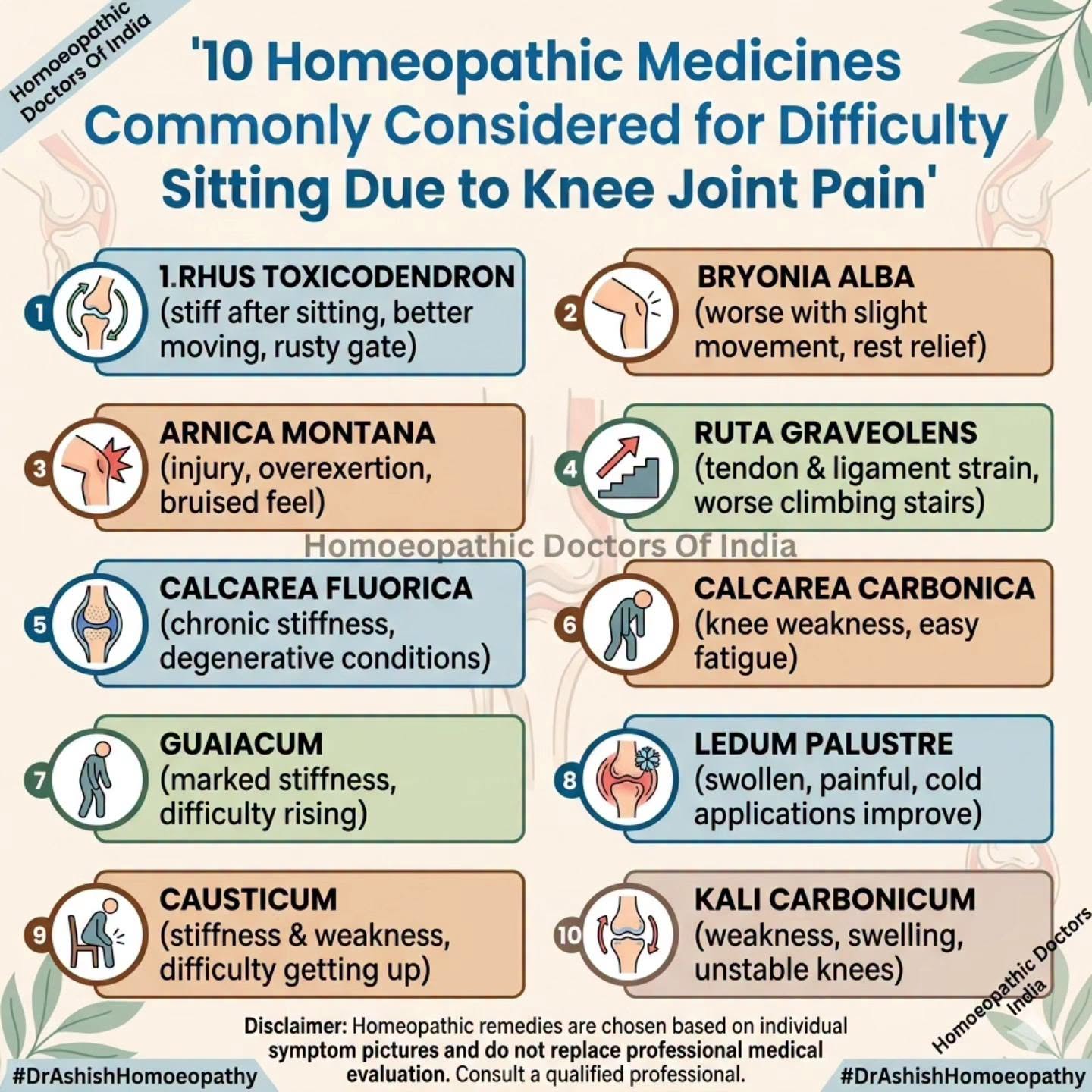
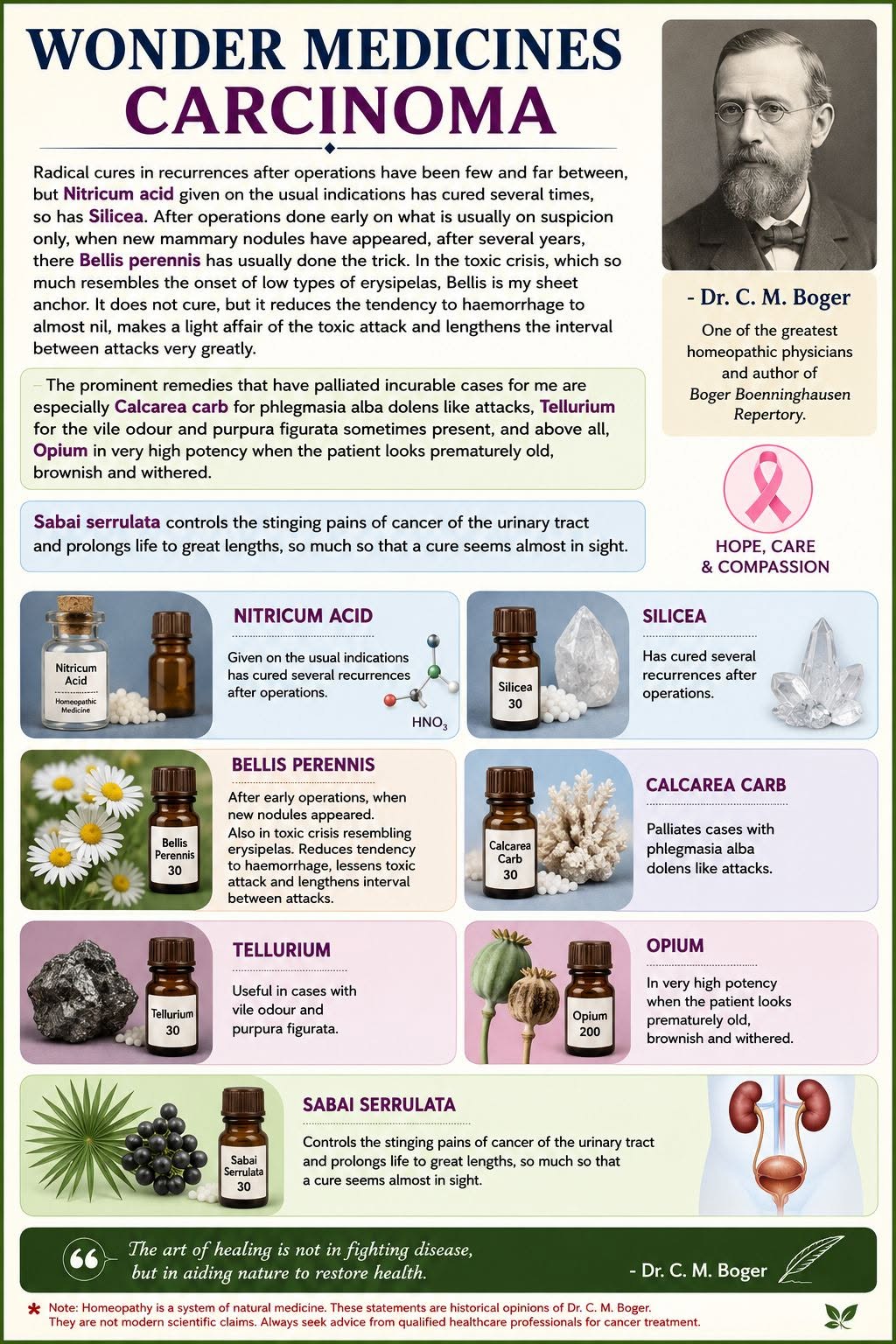
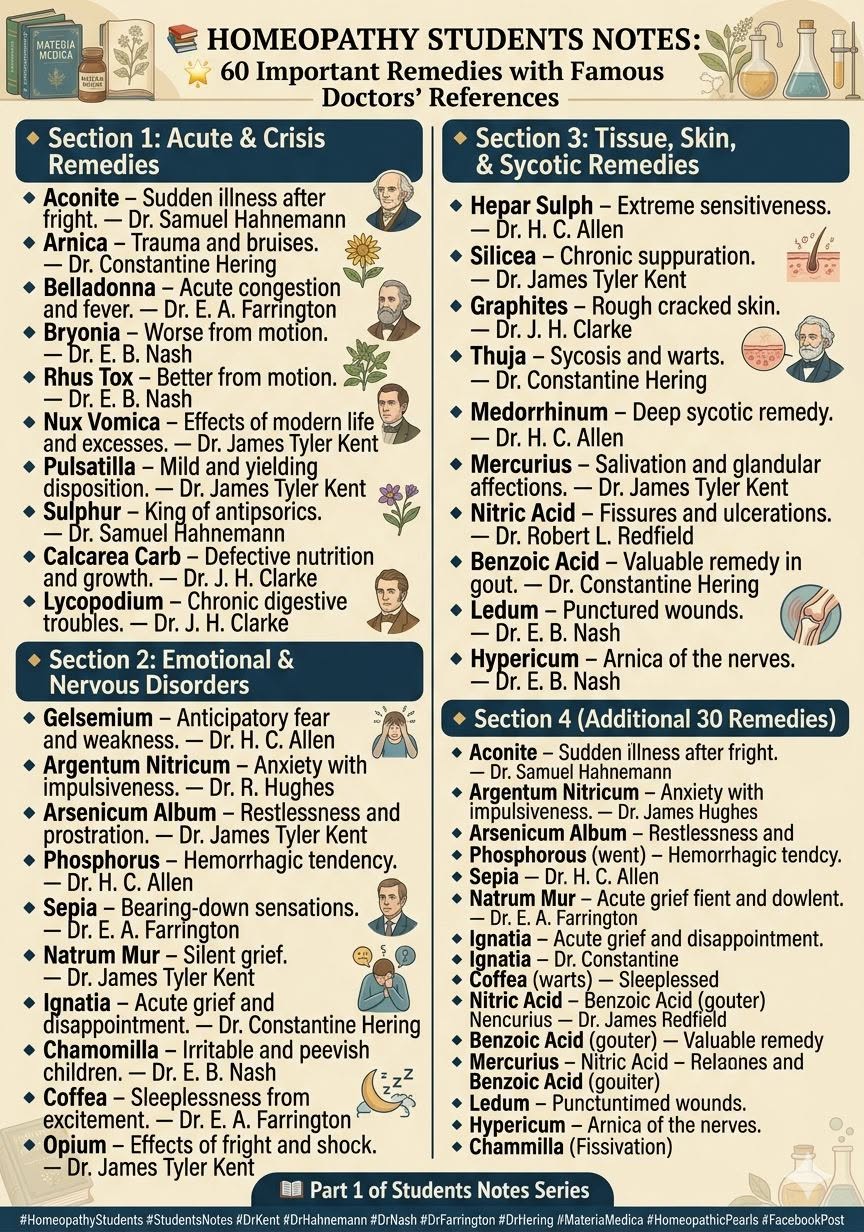
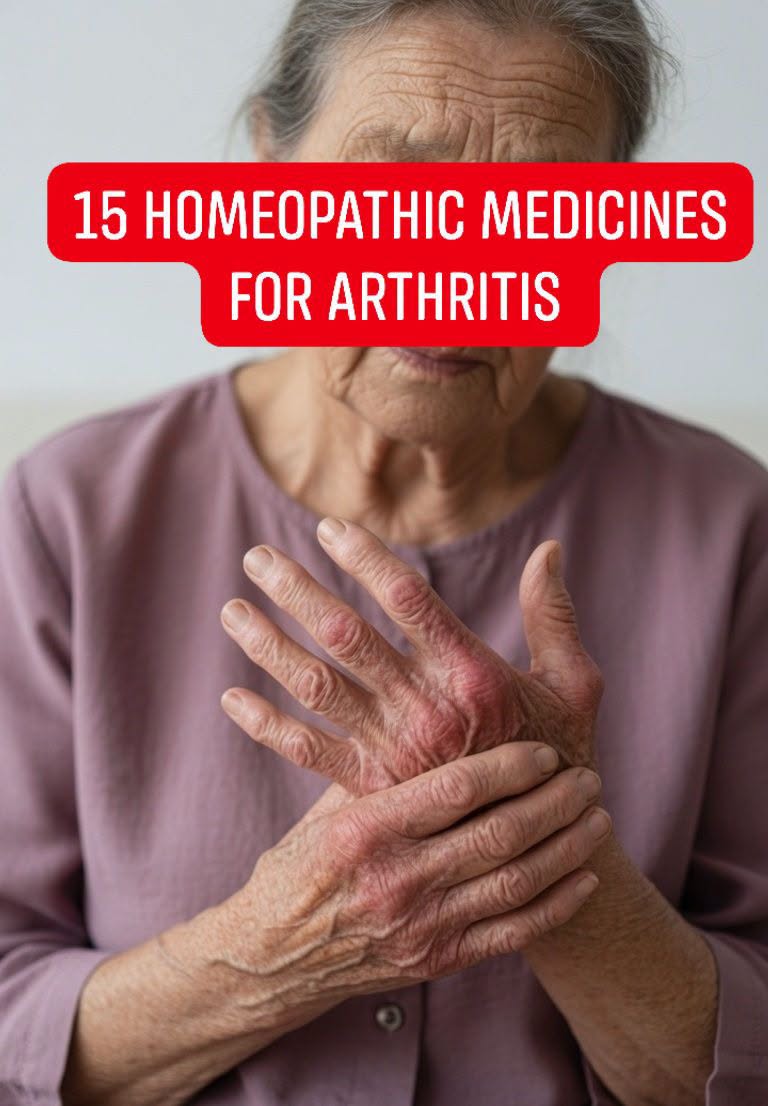
15 Homeopathic Medicines for Arthritis
1. Rhus Toxicodendron
Best for: Stiffness and pain that improve with movement.
Key Symptoms:
Joint stiffness after resting.
Pain worse in cold, damp weather.
Difficulty getting up after sitting.
Better from warm applications and gentle movement.
Common Potency: 30C or 200C.
2. Bryonia Alba
Best for: Pain aggravated by the slightest movement.
Key Symptoms:
Swollen, hot joints.
Severe pain on movement.
Better with complete rest and pressure.
Dryness and thirst are often present.
Common Potency: 30C.
3. Arnica Montana
Best for: Bruised, sore feeling in joints.
Key Symptoms:
Joint pain after injury or overexertion.
Soreness as if beaten.
Tenderness on touch.
Common Potency: 30C.
4. Ledum Palustre
Best for: Gout and painful swollen joints.
Key Symptoms:
Pain starts in feet and moves upward.
Joints feel cold but improve with cold applications.
Swelling and redness.
Common Potency: 30C.
5. Calcarea Carbonica
Best for: Chronic arthritis in people who tire easily.
Key Symptoms:
Weakness and fatigue.
Sensitivity to cold.
Sweating, especially on the head.
Stiff joints.
Common Potency: 30C.
6. Causticum
Best for: Long-standing arthritis with stiffness.
Key Symptoms:
Joint contractures and weakness.
Difficulty walking.
Better in warm weather.
Worse in cold, dry weather.
Common Potency: 30C or 200C.
7. Colchicum Autumnale
Best for: Acute gouty arthritis.
Key Symptoms:
Extremely painful, red, swollen joints.
Pain worsens by touch.
Often affects the big toe.
Common Potency: 30C.
8. Actaea Spicata
Best for: Arthritis of small joints.
Key Symptoms:
Swollen fingers and wrists.
Pain from slight movement.
Tender joints.
Common Potency: 30C.
9. Kalmia Latifolia
Best for: Shifting rheumatic pains.
Key Symptoms:
Sharp, shooting pains.
Pain travels from one joint to another.
Weakness and numbness.
Common Potency: 30C.
10. Ruta Graveolens
Best for: Strained joints and tendons.
Key Symptoms:
Stiffness and soreness.
Pain after overuse.
Weakness around joints.
Common Potency: 30C.
11. Guaiacum
Best for: Severe stiffness and contracted joints.
Key Symptoms:
Swollen, painful joints.
Difficulty moving.
Worse from heat.
Common Potency: 30C.
12. Benzoic Acid
Best for: Arthritis associated with high uric acid.
Key Symptoms:
Cracking joints.
Gouty pains.
Dark, strong-smelling urine.
Common Potency: 30C.
13. Sulphur
Best for: Chronic inflammatory arthritis.
Key Symptoms:
Burning joint pains.
Morning stiffness.
Heat and redness in joints.
Common Potency: 30C.
14. Pulsatilla
Best for: Wandering joint pains.
Key Symptoms:
Pain changes location.
Worse in warm rooms.
Better in fresh air.
Common Potency: 30C.
15. Lithium Carbonicum
Best for: Gout and uric acid-related arthritis.
Key Symptoms:
Pain in small joints.
Swollen and stiff joints.
Symptoms worse at night.
Common Potency: 30C.
Important Note
Homeopathic medicines are selected according to an individual’s symptoms
and constitution. Persistent joint pain, swelling, or deformity should be
evaluated by a qualified healthcare professional to determine the cause,
such as osteoarthritis, rheumatoid arthritis, or gout.
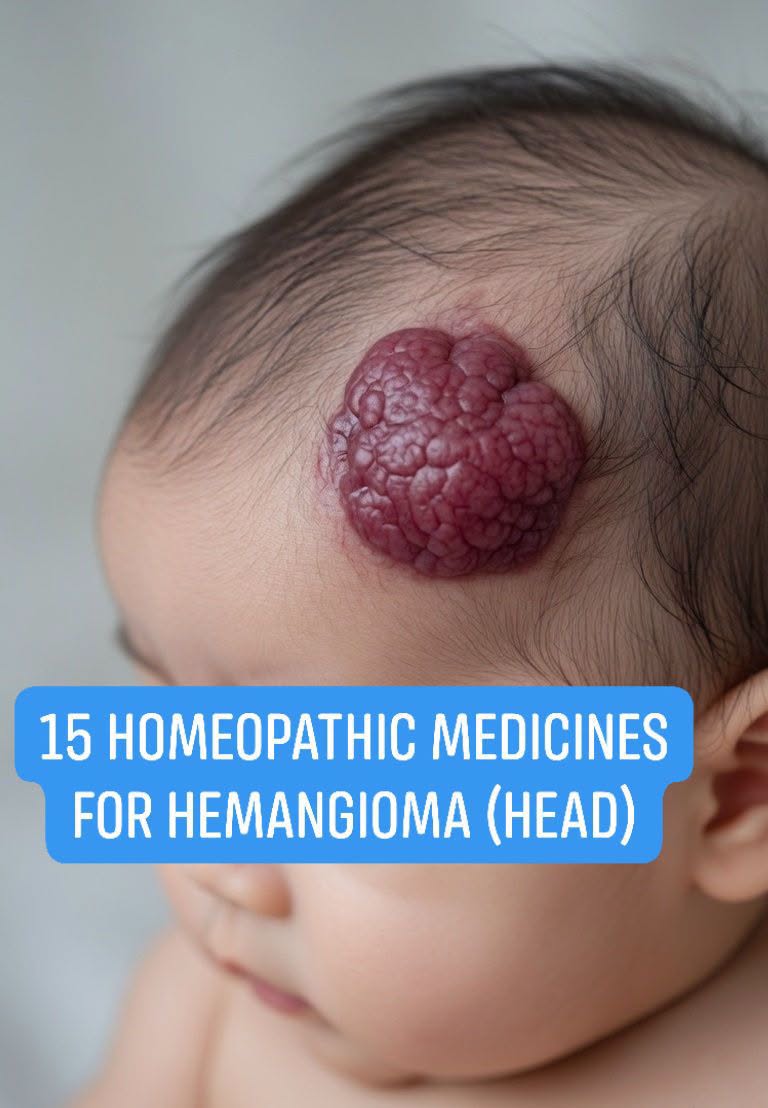
15 Homeopathic Medicines for Hemangioma (Head)
Important: Hemangioma is a benign (non-cancerous) collection of blood vessels.
Large, rapidly growing, painful, or bleeding hemangiomas
1. Calcarea Fluorica
Often considered for hard, vascular growths and tissue abnormalities.
Common potency: 6X or 12X.
2. Thuja Occidentalis
Traditionally used for abnormal skin growths and vascular lesions.
Common potency: 30C.
3. Phosphorus
Considered when there is a tendency toward bleeding and vascular problems.
Common potency: 30C.
4. Hamamelis Virginiana
Often used for venous congestion and bleeding tendencies.
Common potency: Q (mother tincture) or 30C.
5. Arnica Montana
Traditionally used for bruised, tender, and vascular conditions.
Common potency: 30C.
6. Lachesis Mutus
Considered in dark, purplish vascular lesions.
Common potency: 30C.
7. Belladonna
Used when there is redness, heat, and throbbing.
Common potency: 30C.
8. Fluoric Acid
Traditionally considered for vascular and skin abnormalities.
Common potency: 30C.
9. Silicea
Used for chronic skin and tissue conditions.
Common potency: 6C or 30C.
10. Carbo Vegetabilis
Considered in bluish or sluggish circulatory conditions.
Common potency: 30C.
11. Baryta Carbonica
Sometimes used in glandular and developmental disorders.
Common potency: 30C.
12. Sulphur
A commonly used constitutional remedy for chronic skin conditions.
Common potency: 30C.
13. Graphites
Used for chronic skin complaints and tissue changes.
Common potency: 30C.
14. Nitric Acid
Considered for sensitive, bleeding lesions.
Common potency: 30C.
15. Crotalus Horridus
Traditionally used for hemorrhagic and vascular conditions.
Common potency: 30C.
Disclaimer: The above medicines are for educational information only and are not
a substitute for professional medical advice. If a hemangioma on the head is rapidly
enlarging, ulcerated, bleeding, or causing vision or breathing problems,
seek medical evaluation promptly.

10 Homeopathic Medicines for Left-Sided Facial Paralysis (Facial Palsy)
1. Causticum 30 – One of the most commonly used remedies for facial paralysis,
especially when weakness is more marked on the left side and after exposure to cold wind.
2. Aconitum Napellus 30 – Useful when facial paralysis develops suddenly
after exposure to cold, dry winds and is accompanied by anxiety and fear.
3. Belladonna 30 – Indicated when there is redness,
heat, throbbing, and sudden onset of facial weakness.
4. Gelsemium 30 – Helpful for facial paralysis with marked
weakness, heaviness, trembling, and drooping of facial muscles.
5. Plumbum Metallicum 30 – Considered in paralysis with
muscle wasting and marked weakness of facial muscles.
6. Nux Vomica 30 – May be useful when facial paralysis
follows stress, overwork, or exposure to cold.
7. Hypericum Perforatum 30 – Used when facial paralysis
is associated with nerve injury or nerve pain.
8. Rhus Toxicodendron 30 – Helpful when symptoms worsen
in cold, damp weather and improve with movement.
9. Arnica Montana 30 – Considered when facial paralysis
follows trauma or injury.
10. Lachesis 30 – Sometimes used for left-sided complaints
with increased sensitivity and circulatory disturbances.
Common Symptoms of Left Facial Paralysis
Drooping of the left side of the face
Difficulty closing one eye
Crooked smile
Difficulty speaking or eating
Drooling of saliva
Altered taste sensation
Important: Sudden facial paralysis can be caused by conditions such as Bell’s palsy
or stroke. If weakness starts suddenly, especially with arm or leg weakness,
difficulty speaking, or severe headache, seek immediate medical attention.
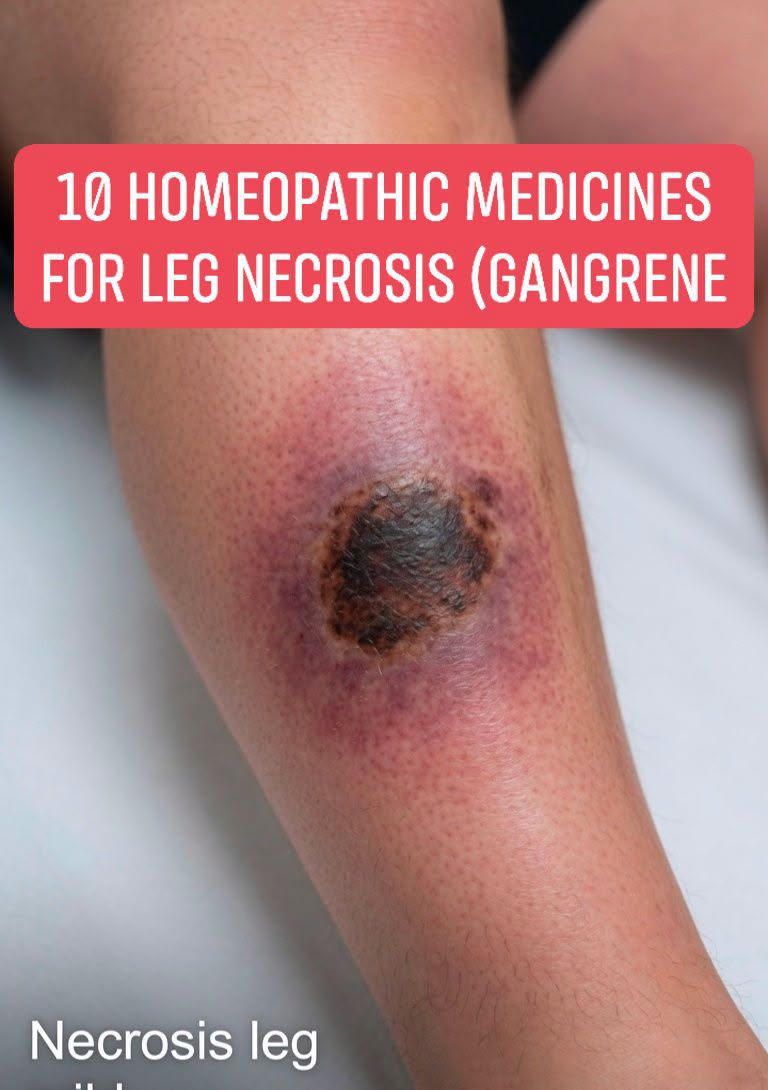
10 Homeopathic Medicines for Leg Necrosis (Gangrene)
1. Arsenicum Album 30
Traditionally used for burning pain, restlessness,
weakness, and ulcers that tend to become gangrenous.
2. Secale Cornutum 30
Considered in dry gangrene, where the affected part
becomes cold, dark, shriveled, and numb.
3. Anthracinum 30
Traditionally used for severe tissue destruction,
septic conditions, and rapidly spreading ulcers.
4. Lachesis 30
May be considered when the skin appears bluish,
purple, or black with marked sensitivity.
5. Carbo Vegetabilis 30
Used in cases of poor circulation, cold limbs,
and bluish discoloration due to reduced oxygen supply.
6. Tarentula Cubensis 30
Traditionally used for severe inflammation,
abscess formation, and tissue breakdown with intense pain.
7. Crotalus Horridus 30
Considered when there is dark discoloration,
bleeding tendency, and tissue degeneration.
8. Calendula Officinalis 30
Used to support wound healing and
recovery of damaged tissues.
9. Silicea 30
Traditionally considered for chronic ulcers
and slow-healing wounds.
10. Echinacea Angustifolia 30
Used in homeopathy for infected wounds
and septic conditions.
General Dose
30C potency: 3–4 pills under the tongue once or twice daily,
preferably under the guidance of a qualified homeopathic practitioner.
Important Disclaimer
Leg necrosis (gangrene) is a medical emergency. Black discoloration, severe pain,
foul-smelling wounds, fever, or rapidly spreading infection require immediate
medical attention. Homeopathic remedies should not replace emergency
medical or surgical treatment.
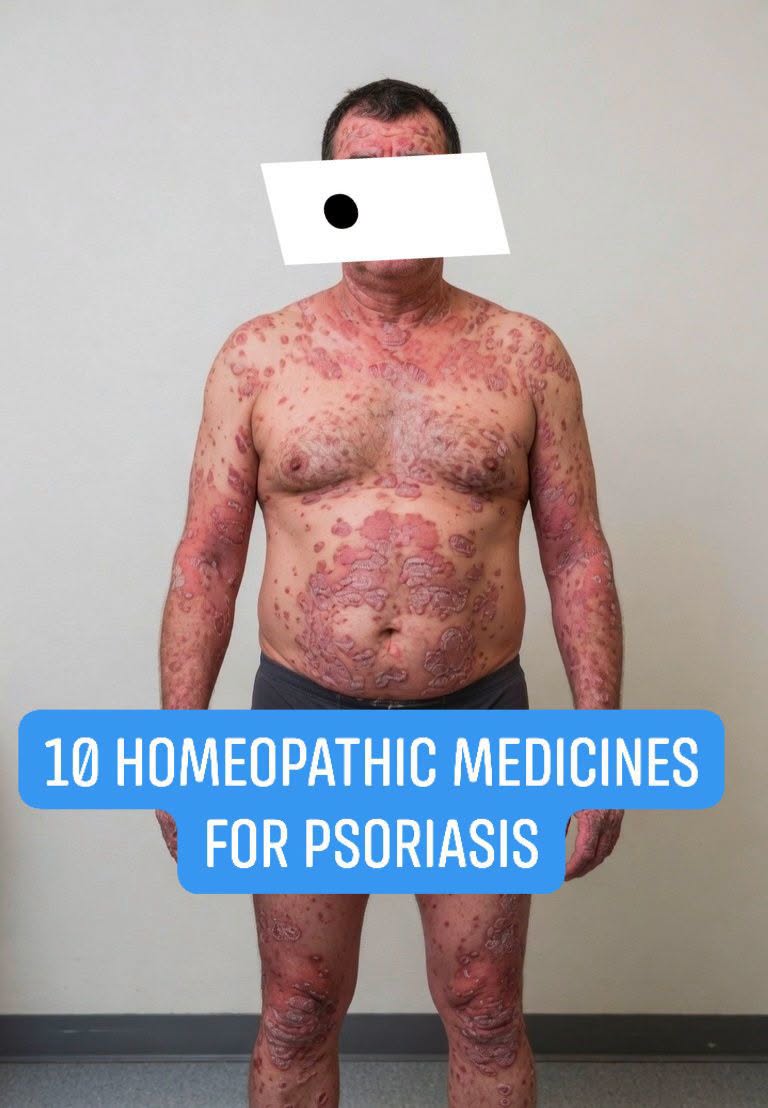
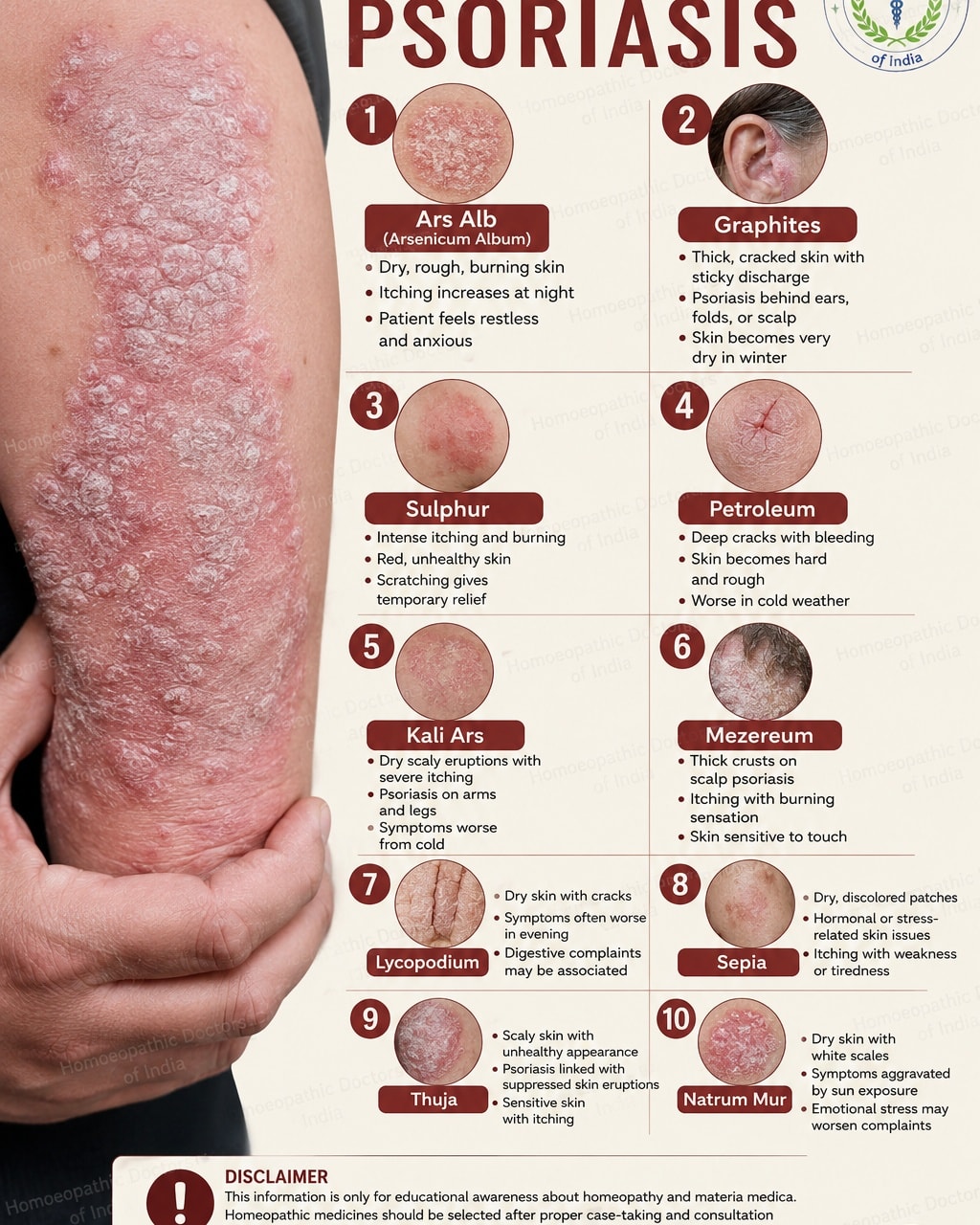
10 Homeopathic Medicines for Psoriasis
1. Arsenicum Album
For dry, rough, and burning skin.
Itching is worse at night.
Suitable for people who feel weak and restless.
2. Graphites
For thick, cracked skin with sticky discharge.
Helpful when psoriasis affects skin folds
or behind the ears.
3. Sulphur
Intense itching and burning.
Symptoms worsen from heat and warmth.
Skin is red and covered with scales.
4. Petroleum
For psoriasis that becomes worse in winter.
Deep cracks and bleeding of the skin.
5. Sepia
Dry, rough, and discolored skin.
Symptoms may worsen with hormonal changes.
6. Mezereum
Thick crusts and severe itching.
Burning sensation under the scales.
7. Kali Arsenicosum
For chronic and stubborn psoriasis.
Severe itching and burning, especially at night.
8. Thyroidinum
Used in recurrent psoriasis with metabolic
or hormonal issues.
9. Lycopodium
For dry, thick, and scaly skin.
Often considered in long-standing cases.
10. Tuberculinum
For recurrent psoriasis that tends to flare up repeatedly.
Symptoms may worsen with weather changes.
Common Dose
30C potency: 3-4 pills once or twice daily, only under
the guidance of a qualified homeopathic practitioner.
Disclaimer: Homeopathic medicines should not replace medical advice.
Consult a qualified healthcare professional for proper diagnosis
and treatment of psoriasis.

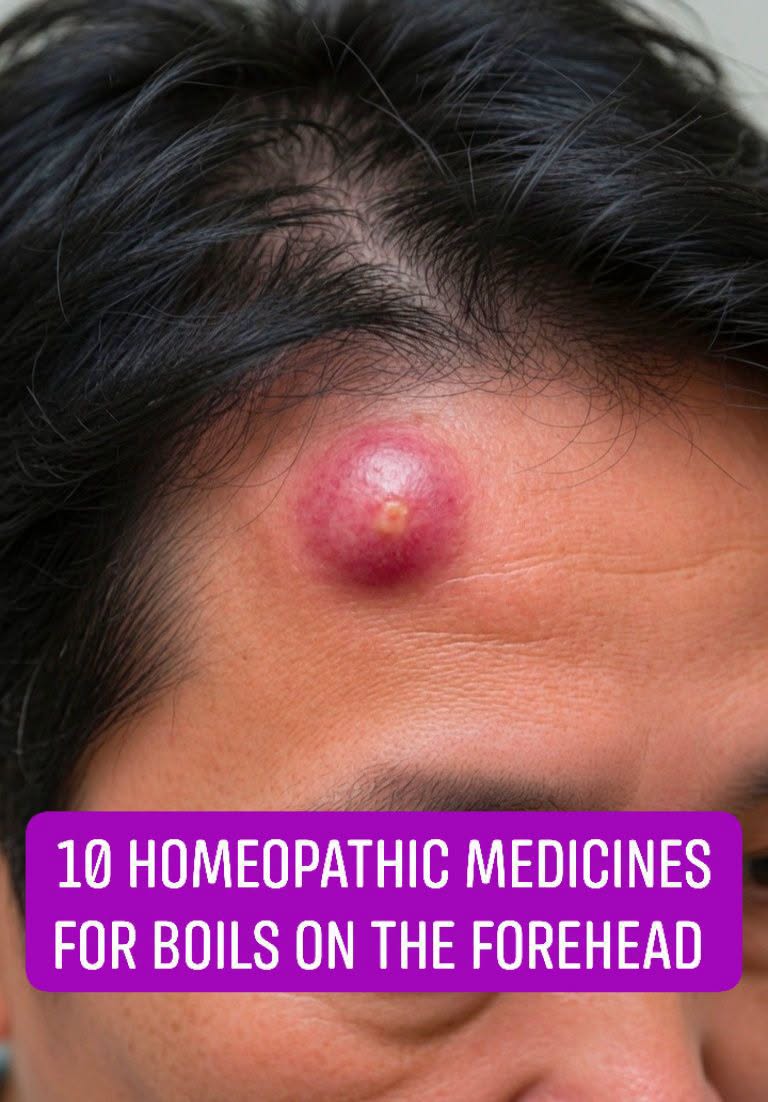
10 Homeopathic Medicines for Boils
on the Forehead (Forehead Abscess/Furuncle)
⚠️ Note: Homeopathic medicines should be selected according
to individual symptoms. If the boil is very painful, repeatedly
comes back, causes fever, or swelling spreads around the eyes,
seek medical attention.
1. Belladonna
Red, hot, throbbing boil.
Sudden swelling and intense pain.
Dose: 30C, 3-4 pills, 2-3 times daily.
2. Hepar Sulphuris Calcareum
Boil is very sensitive to touch.
Helps when pus has formed.
Dose: 30C, twice daily.
3. Silicea
Recurrent boils with slow healing.
Helps in draining pus naturally.
Dose: 30C, once or twice daily.
4. Mercurius Solubilis
Boil with yellow discharge and sweating.
Worse at night.
Dose: 30C, twice daily.
5. Calcarea Sulphurica
Thick yellow pus that continues to ooze.
Delayed healing.
Dose: 30C, twice daily.
6. Arnica Montana
Sore, bruised feeling around the boil.
Useful after minor injury to the forehead.
Dose: 30C, twice daily.
7. Sulphur
Recurrent boils with itching and burning.
Unhealthy skin prone to infections.
Dose: 30C, once daily.
8. Myristica Sebifera
Often called the „homeopathic knife“ for abscesses.
May help promote drainage of pus.
Dose: 30C, twice daily.
9. Gunpowder
Recurrent boils and suppurative skin infections.
Dose: 30C, twice daily.
10. Calendula Officinalis
Supports healing of the skin after the boil opens.
Dose: 30C, twice daily.
When to See a Doctor
Fever or chills.
Swelling around the eye.
Severe pain or rapidly increasing redness.
Recurrent boils, especially if you have diabetes.
Large boil that does not improve.
Disclaimer: Homeopathic remedies are based on traditional homeopathic practice
and scientific evidence for effectiveness is limited. Persistent or severe boils should
be evaluated by a qualified healthcare professional.
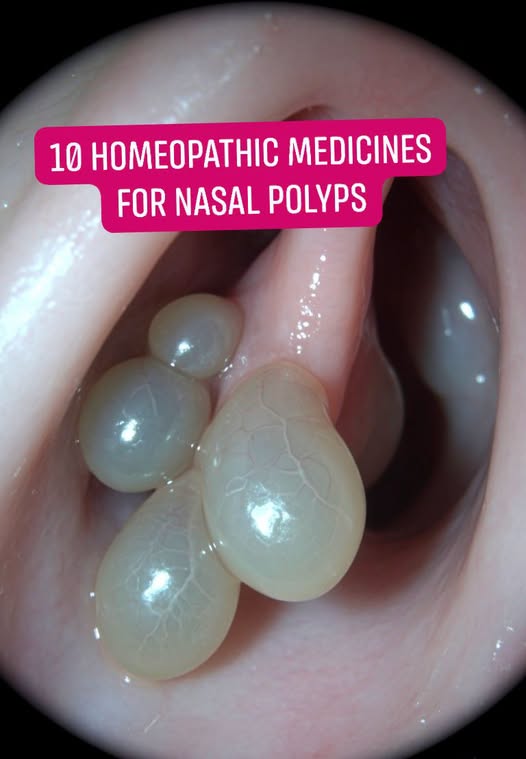
10 Homeopathic Medicines for Nasal Polyps
1. Teucrium Marum Verum 30
Commonly used for nasal polyps with itching in the nose,
frequent sneezing, and a sensation of blockage.
2. Lemna Minor Q
Often considered for nasal polyps associated with
chronic nasal obstruction and reduced sense of smell.
3. Sanguinaria Canadensis 30
May be helpful in right-sided nasal polyps with
recurrent headaches and nasal congestion.
4. Calcarea Carbonica 30
Used in people who frequently catch colds
and have a tendency to develop nasal polyps.
5. Kali Bichromicum 30
Considered when there is thick, sticky yellow
or green nasal discharge along with polyps.
6. Thuja Occidentalis 30
Traditionally used for recurrent polyps
and abnormal tissue growths.
7. Phosphorus 30
May be considered when nasal polyps are
associated with easy bleeding from the nose.
8. Silicea 30
Often used in long-standing cases of
nasal polyps with recurrent infections.
9. Mercurius Solubilis 30
Considered when there is foul-smelling
nasal discharge and inflammation.
10. Pulsatilla 30
May be helpful for nasal congestion with thick
yellow discharge that tends to worsen in the evening.
Disclaimer: Homeopathic medicines should be selected based on individual symptoms
and are not a substitute for medical evaluation. Large or recurrent nasal polyps may
require assessment by an ENT specialist. Seek professional medical advice before
starting any treatment.
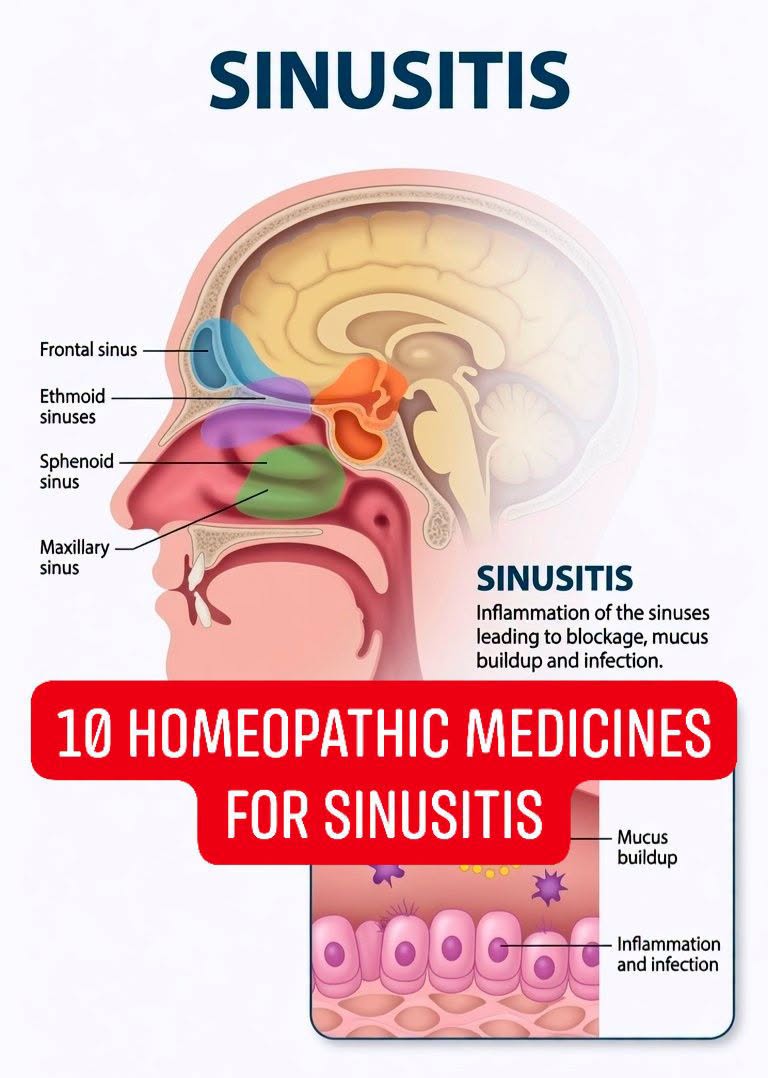
10 Common Homeopathic Medicines for Sinusitis
1. Kali Bichromicum 30C
Indications: Thick, sticky, stringy yellow or green mucus with severe pain
at the root of the nose or forehead. Pain is often in one small spot.
Dose: 30C, 3–5 pellets, 2–3 times daily during acute symptoms.
2. Pulsatilla 30C
Indications: Thick yellow or green discharge, blocked nose at night,
symptoms improve in fresh air and worsen in warm rooms.
Dose: 30C, 3–5 pellets, 2–3 times daily.
3. Belladonna 30C
Indications: Sudden onset with throbbing headache,
fever, facial redness, and intense sinus pain.
Dose: 30C, 3–5 pellets, every 6–8 hours as needed.
4. Mercurius Solubilis 30C
Indications: Foul-smelling nasal discharge,
increased salivation, and symptoms worse at night.
Dose: 30C, 3–5 pellets, 2–3 times daily.
5. Hepar Sulphuris Calcareum 30C
Indications: Sinus infection with extreme sensitivity
to cold air, pus formation, and sharp pain.
Dose: 30C, 3–5 pellets, twice daily.
6. Silicea 30C
Indications: Chronic or recurrent sinusitis
with thick discharge and slow recovery.
Dose: 30C, once or twice daily under professional guidance.
7. Hydrastis Canadensis Q (Mother Tincture)
Indications: Thick, sticky yellow mucus with chronic
nasal congestion and post-nasal drip.
Dose: 10–15 drops in ¼ cup of water, 2–3 times daily,
only under the advice of a qualified homeopathic practitioner.
8. Sanguinaria Canadensis 30C
Indications: Right-sided sinus pain with severe headache,
especially over the right eye.
Dose: 30C, 3–5 pellets, twice daily.
9. Arsenicum Album 30C
Indications: Burning nasal discharge, restlessness,
weakness, and symptoms worse after midnight.
Dose: 30C, 3–5 pellets, 2–3 times daily.
10. Natrum Muriaticum 30C
Indications: Recurrent sinusitis after frequent colds
with alternating nasal blockage and watery discharge.
Dose: 30C, once or twice daily as advised
by a homeopathic practitioner.
Important Note
Homeopathic remedies are selected based on the individual’s complete symptom picture, not just the diagnosis of sinusitis. Evidence for homeopathy in treating sinusitis is limited, and these remedies should not replace appropriate medical care.
Seek immediate medical attention if you have:
High fever
Swelling around the eyes
Severe facial swelling
Vision changes
Confusion
Symptoms lasting more than 10 days without improvement
or becoming significantly worse after initial improvement.
Disclaimer: This information is for educational purposes only and is not a substitute
for professional medical advice, diagnosis, or treatment. Always consult a qualified
healthcare professional before starting any medication.
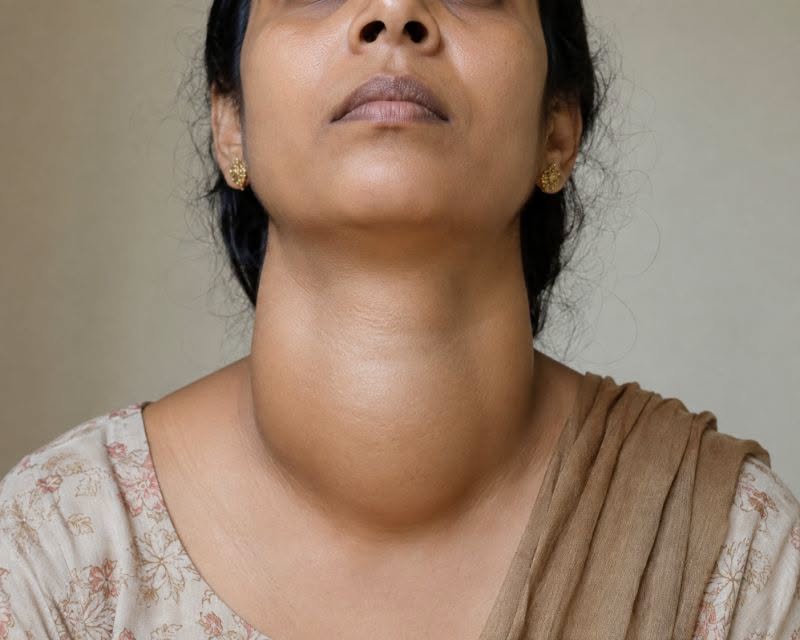
GOITRE AND HOMEOPATHY
Goitre is an abnormal enlargement of the thyroid gland.
Thyroid is a butterfly-shaped gland located at the base of the neck just
below the Adam’s apple. Although goitres are usually painless, a large goitre
can cause a cough and make it difficult to swallow or breathe.
Important warning signs
• A rapidly enlarging neck swelling
• Difficulty swallowing or breathing
• Hoarseness of voice
• Painful thyroid swelling
• Unexplained weight loss, marked palpitations,
tremor, or severe fatigue
HOMEOPATHY
Homoeopathy today is a rapidly growing system and is being practiced all over the world. Its strength lies in its evident effectiveness as it takes a holistic approach towards the sick individual through promotion of inner balance at mental, emotional, spiritual and
physical levels. When goitre is concerned there are many effective medicines
available in Homoeopathy, but the selection depends upon the individuality
of the patient, considering mental and physical symptoms.
IODUM: Enlarged thyroid with weight loss, heat intolerance, excessive appetite, restlessness, and hyperthyroid tendencies. It is more suitable to spare dark, active patients.
There is marked hardness with sensation of constriction. Enlargement of the two
lobes occurs, tumour becoming more swollen and painful at return of each menses.
Grandular increase in size, especially right side , soft and without any fluctuation.
Nonlobulated tumour in interior and medium portion of the size as large as a child’s head, rosy red, heavy in weight and soft is cured by this remedy. Goitre soft with heat and rapid pulse. Iodum patient feels excessive palpitation which get worse from even slight exertion. Extreme weakness and the weakness is mainly felt ongoing upstairs. Feeling excessive heat in body and wanting to stay in a cool. Mentally the person is very anxious about present
issues and not about future.
BROMIUM: When Iodum fails, this remedy should be tried in high dilutions.
There is enlargement of glands with softness. Cannot lies on right side because
of palpitation is a leading symptom of this remedy. The Spongia patient is light
complexioned, scrofulous and is buoyant and cheerful.
THYROIDINUM: Thyroidinum may be tried if Iodum and Bromium fails.
NATRUM MURIATICUM: Goitre, mainly for patients who are irritated very easily and get
upset over little things. The person remains depressed with weeping when alone and
it always gets aggravated when someone tries to console. The persons requiring this
medicine feel very hot and cannot bear the heat of sun. They suffer from severe headaches when exposed to sun. Craving for excess salt and salty foods. Hypothyroid tendencies,
losing weight despite having regular and proper meals. The person looks very weak,
especially around the neck region. The patient feels very weak especially
in morning when in bed.
LACHESIS: Early stages of goitre, on the left side. Body feeling extremely hot.
Such patients cannot wear tight clothes and always keep their collars around the neck
and the belt around the waist loose. The mental symptoms that are usually considered
are sadness with an aversion to do any kind of work. The person does not wish to mix
up and wants to go somewhere alone. Excessive talkativeness is a leading mind
symptom for the use of Lachesis
SPONGIA TOSTA: – Hard, enlarged thyroid; sensation of pressure or choking in the
neck; dry cough. causing suffocating spells at night. It is suitable for painful goitre.
There is asthma with amenorrhea. Pain on swallowing.
FUCUS VESICULOSUS: Thyroid enlargement in obese persons.
There are indigestion, flatulency and constipation.
CALCAREA CARBONICA: – Soft glandular enlargement in people who tire easily,
gain weight easily, feel cold, and perspire excessively, especially on head and neck.
Craving for eggs.
CALCAREA IODATA: Thyroid enlargement at the time of puberty.
LAPIS ALBUS: Goitre with burning and stinging pain in breasts, stomach and uterus.
Scrofulous enlargement of glands. Glands have a certain elasticity and pliability.
BARYTA CARBONICA: Glandular swellings, especially in older adults
or people with sluggishness and shyness.
LYCOPUS VIRGINICUS: Goitre with heart trouble, palpitations and breathlessness.